
 Mosaic art is very old. It has spread widely in the ancient world due to the Greeks who used this type of ornament to “adorn” their floors. Later, it extended to the walls, giving birth to the Byzantine mosaic that we can admire today especially in churches.

Bucharest has a number of places of worship plated with mosaic or adorned with icons made in this style. Although the mosaic technique is much more expensive than the mural painting, for example, it is preferred in new church constructions because such a work can last hundreds of years without requiring any new intervention.
We will also walk through some of the churches in Bucharest that stand out due to the mosaic works they include. In this way we will be able to discover the beauty of this art form which requires not only talent, but also skill and a lot of carefulness.
Murano glass mosaics
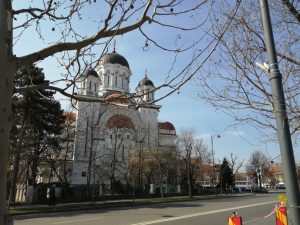
One of the most famous churches in Bucharest is Cașin, a place that many of us know as “Cașin Monastery”.
Even though it is a “young” place of worship, born in 1935, it is fascinated by its special beauty resulting from the grandeur of the Byzantine style which blends perfectly with the brâncovenesc style. The building, located on Mărăști Boulevard very close to the Triumphal Arch, is an eloquent example for the Neo-Romanian architectural style.
White on the outside, with a supple cross-shaped figure, which rises to the sky, the Cașin Church stands out, in front of the viewer, through the huge mosaic, on the facade, which depicts the protectors of the place, Saints Michael and Gabriel.
The spectacularity of the construction is enhanced by the high steps that must be followed to enter the church, but also by the entrance doors that are adorned with bas-reliefs cast in bronze, which represent the Holy Apostles Peter and Paul and the Holy Archangels Michael and Gabriel.
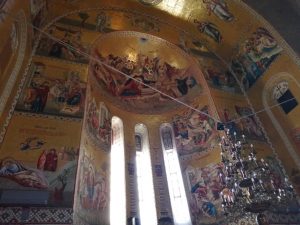
The interior of the church is amazing, where the mosaics made entirely of Murano glass are dominant. The mosaic icons perfectly adorn the pillars and walls of the altar. The iconostasis is plated with white marble, contrasting shades giving rise to a refined, elegant whole.

We have already mentioned that the Cașin Church is a “young” place in the landscape of Bucharest. Just as “young” are the mosaic works that we can admire here.
For those who remember the communists’ attitude towards religion, the fact that the place of worship in District 1 of the Capital was adorned with Murano glass mosaic, starting with the 70’s, is a big surprise.
The surprise is even greater, given that, between 1956-1960, the Cașin Monastery was closed by the Communists, and the archive was confiscated.
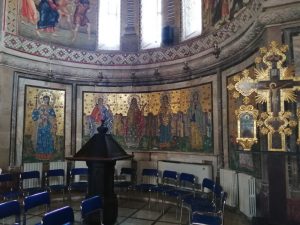
However, the clergy of the time have succeeded in reopening the church. Moreover, they were able to carry out rehabilitation work. Thus, between 1962-1977, there were made the marble panels, the cafasse and the mosaic icons on the iconostasis.
After 1989, new interventions were made to bring the church to its present state.
Mosaic icons
And the Radu Voda Monastery, a church from the time of the voivode Alexander II Mircea (1568-1577), has some mosaic icons. The works have been realized within the actions of rehabilitation of the place of worship carried out in the last years.
The construction was built with the intention of becoming Metropolis of the Capital, but, throughout history, it has experienced a series of dramatic events that will mark its destiny.
As I mentioned, the initial construction was executed during the reign of Alexander II Mircea, but shortly after its foundation, under the name of Holy Trinity, the place falls into the hands of the Turks. It happened in 1595, when the famous Sinan Pasa transformed the monastery into an Ottoman fortress. The armies led by Michael the Brave force the Turks to retreat, but, as they leave the area, they destroy everything that falls into their hands. The monastery is also one of the victims of this disaster made by the Ottomans, being demolished to the ground.
Its reconstruction took place only in 1614, during the reigns of Radu Mihnea. The voivode orders for the place of worship to respect the architecture of the Episcopal Church at Curtea de Argeș. The only difference is that the stone was replaced with brick. In the rest, the triconch plan, with a tower on the naos, with an enlarged pronaos, covered with three towers, the main one is supported on twelve columns, symbolizing the twelve apostles.
The mosaic icons that we find both at the entrance of the monastery and inside it are special too. Various biblical scenes are rendered from the crafted combination of glass.
Same as the works from the Cașin Monastery those from Radu Vodă have also been carried out in recent years and represent the desire of the clerics to highlight the historical monuments and to ensure that the works that are executed will last for years.
Mosaic works also appear in other churches in Bucharest. Most of them are recent constructions.
In this sense, we can remember the Church “Cover of the Virgin Mary” – Titan, a place of worship erected in 2001 or the Church “Holy Great Martyr Mercurius”, built in 2003.
Unique mosaic in the Orthodox world
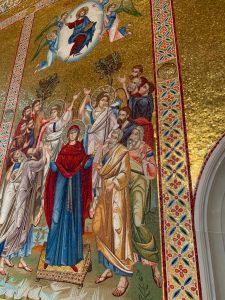
And yet, the most spectacular work performed in the mosaic technique is represented by the iconostasis of the People’s Salvation Cathedral.
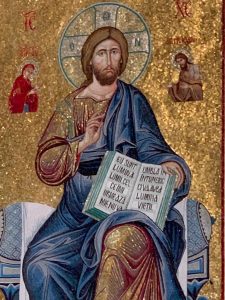
The work is unique in the Orthodox world, due to its impressive dimensions: 23 meters wide and 18 meters high. No less than eight tons of mosaic were needed to execute this real “painting”.
Daniel Codrescu, the painter who coordinated the entire work of making the iconostasis, said it was chosen the mosaic technique because the life of the People’s Salvation Cathedral was calculated for at least 500 years. In these conditions, the mosaic was taken into account, which is the most resistant technique in time and which has certain aesthetic and liturgical valences, fitting very well in a building of such dimensions.
“Usually, in an iconostasis there are four royal icons, here we have six, which helped us to represent the two dedications, “Ascension of the Lord” and “Saint Andrew the Apostle”. On the left, we placed the icons of Saints Nicholas and John the Baptist, two of the most beloved saints in the Romanian space. Also as a peculiarity, in the register of the holy apostles we have the Holy Trinity, which in this case occupies the place of the Righteous Judge, which was moved to the royal icon of the Savior Jesus Christ. Thus, together with the icon of the Virgin Mary and Saint John the Baptist, we have symbolized the Deisis icon. The Holy Trinity was chosen by His Beatitude Father Daniel precisely in the idea of emphasizing the quotation from the Holy Scripture that says, “Go, teach all the nations, baptizing them in the name of the Father and of the Son and of the Holy Spirit” (Matthew 28, 19). The holy apostles preach the teaching of the Holy Trinity, being the representatives who baptize the nations. Considering that this cathedral is an important edifice of the Romanian people, this representation fits well from an iconographic and theological point of view”, Daniel Codrescu said in an interview for Lumina Newspaper.
The materials used were brought from abroad, from Venice and Murano.
Daniel Codrescu did not work alone on this masterwork, but he had a team of 40 experts in mosaic technique. The icons were executed in the workshop, where they were pre-assembled, and then they were mounted in situ in the People’s Salvation Cathedral.
The entire painting that will adorn the interior of the People’s Salvation Cathedral is made entirely in mosaic technique, thus highlighting the importance that this edifice has for our country.

Author: Ștefania Enache
Photo: Corina Gheorghe