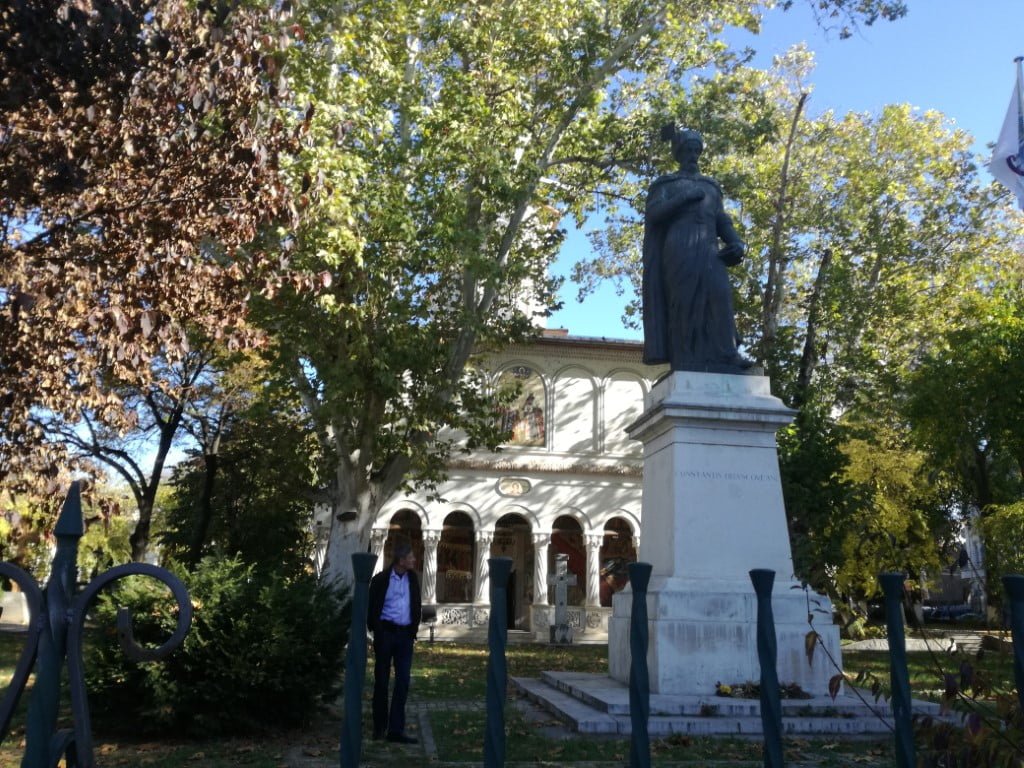

 We will go back in time yet again to dig out several memorable events in the history of this city. “The tourist among vestiges” begins his journey today at Biserica Sfântul Gheorghe Nou / The New Saint George Church, will take a rest at Mănăstirea Sfinţii Apostoli / The Holy Apostles Monastery, and will hold a moment of silence at Biserica “Adormirea Maicii Domnului” / “The Assumption of Mary” Church – Sapienţei, where he will get ready for a new journey leading him in the footsteps of the Geto-Dacians.
We are at Kilometer Zero of Romania, a place ennobled by a Church within whose walls many histories related to these lands lie hidden.
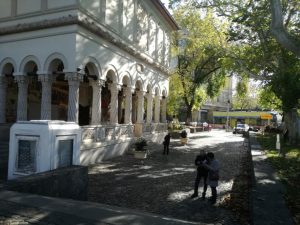
It is an ordinary day of the week, but in the courtyard of the worship place are fairly many people. Some have come to worship and pray, others have come as mere tourists, desirous to see what the last patronage of Holy Martyr Constantin Brâncoveanu looks like.
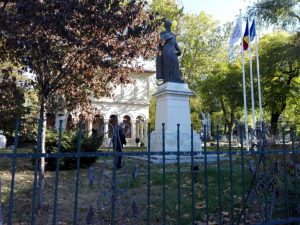
Biserica Sfântul Gheorghe Nou / The New Saint George Church is no ordinary church. Here, even the least religious of men feels the divine thrill. Perhaps the sentiment issues from the atmosphere enveloping the church, or maybe it proceeds from the awareness of the fact that this place is connected to great personalities of our lands.
When you get into the courtyard of the worship place, you can’t help but seeing it is “watched over,” from among the sycamore-trees, by the very Constantin Brâncoveanu. An immense bronze statue of the Martyr-Prince dominates the area. The artwork was performed in 1939 by Artist Oscar Han.
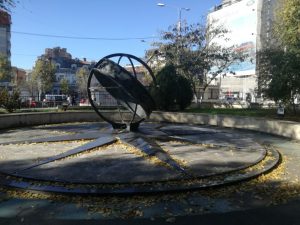
In the same courtyard you will discover another monumental ensemble bearing, among others, the signatures of Sculptor Constantin Baraschi and of the Architects Horia Creangă and Ştefan Niculescu. The interesting artwork “Kilometer 0” was also called by the interwar press “The Heart of the Country.” The monument has a rather sad history, being one of the many “victims” of the Communists.
The monument presents itself in the form of a pool with a wind rose in the middle, among the rays of which are placed in patchwork the insignias of the historical Provinces of Romania, and the names of Capital-cities. In the middle of this pool there is a metal globe including the symbols of all the star signs.
Meant to mark out Kilometer Zero of Romania, the Monumental Ensemble was initially challenged by the Elders of the Church in the interwar period. The opposition of the Church intervened because of the fact that the artwork was designed, initially, in such a way that in its center would stand a statue of Saint George. Citing the second commandment in the Decalogue: “Do not make yourself graven image…,” the Church opposed the initial form of the project.
The Monumental Ensemble “Kilometer 0” has gone through a difficult episode between 1945 and 1947, when the patchwork plates constituting the names of the cities in Bessarabia and Northern Bukovina were snatched away from it.
Once come to power, the Communists ordered the burying of The Monumental Ensemble “Kilometer 0” under a pile of dirt. Only late, in the year 1992, when Biserica Sfântul Gheorghe Nou / The New Saint George Church got into restauration, this interesting monument was unearthed.
The Church in Which You Discover the Real History
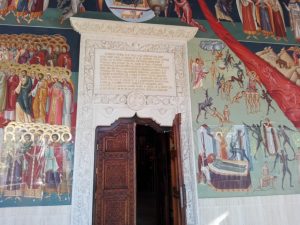
In order to reach the entry into the worship place, you need to climb down a short staircase, whereupon you climb up a number of stone stairs. The structure of the construction reminds you of the fact that, upon getting within its walls, you rise higher and are closer to the heaven.
Not only the stairs that you climb up afford greatness to the construction. The same thing can be said about the 5-meter-high door guarding the entry, and that stands out by a series of extremely beautiful ornamental elements. When the restauration of the worship place was performed, they succeeded to preserve the original door and refurbish it.
The columns supporting the Church afford robustness to the construction and make clear reference to the Brâncovenesc style distinctive to this worship place.
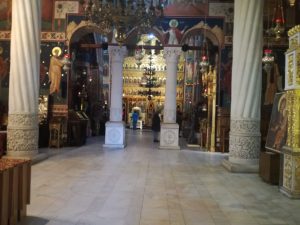
Once you entered the church, you are struck by the immensity of the place, by the wideness thereof. To me, for one, it gave the sensation of a museum in which you need to stay and study at length every exhibit. And what I’m saying is not a blasphemy, but it’s a recognition of the divine creation presenting itself to us in various forms.
The furniture in the Brâncovenesc style spectacularly dresses the inside. The same thing does the fresco painting in the nave and the narthex, that the team led by Painter Ioan Moldoveanu brought back to life. At one time, here were artworks of house-painter Pârvu Mutu, but the time was merciless with the labor of the master, and there was a need for a repainting.
Huge bronze chandeliers and delicate candles complete the unique atmosphere within this Church.
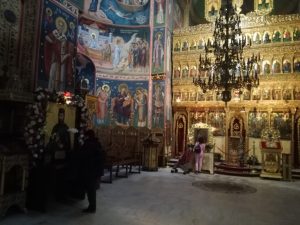
I stopped, in turn, in front of each of the icons adorning the walls, but my steps were heading unwillingly to the place the most heavily loaded in this area. Located at the right side of the nave, as you look toward the altar, the tomb of the Holy Voivode Constantin Brâncoveanu compels you to think about the immense sacrifice that this Prince made on behalf of his faith. His tomb constitutes a proof of what dignity and patriotism really mean.
Fairly close to the tomb of the Martyr Prince there is an icon whose story represents a history lesson that we have no right to forget. The Saint Parascheva’s wonder-performing icon ended up in this worship place after the Communists ordered the demolition of Biserica Sfânta Vineri / The Great Friday Church. The Church’s liturgical ornament, dated sometime around the 18th century was restored about more than ten years ago and presents itself, as a testimony of the history of Bucharest in the eyes of the one truly wanting to understand what happened on these lands.
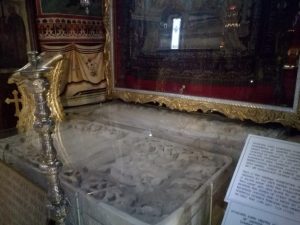
Opposite to the tomb there is another proof of the beautiful history that we have. The shrine containing the relics of Saint Hierarch Nicholas is a real jewel of pure silver. Gilded and ornated with precious stones, the shrine is reminiscent of another great historical personality.
Historical sources indicate the fact that the Church has received as a gift the right hand of Saint Nicholas from the very Voivode Michael the Brave and Madame Stanca.
The relics offered, according to Chronicler Radu Greceanu in the year 1599, ennobled the first Church erected on this place. Later on, the successive steps in remodeling the worship place did not bereave the Church of these important liturgical ornaments.
“Biserica Sfinţii Apostoli” / The Holy Apostles Church Was Salvaged by the 1989 Revolution
We leave Biserica Sfântul Gheorghe Nou / The New Saint George Church, and we head toward another place heavily laden with history: Biserica “Adormirea Maicii Domnului” / “The Assumption of Mary” Church – Sapienţei. But before stopping in the small chapel bearing the signature of Painter Gheorghe Tattarescu, we pass by Biserica Sfinţii Apostoli / The Holy Apostles Church.
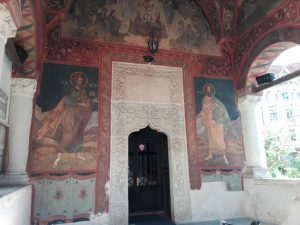
The abode patronaged by Matei Basarab hides itself today among the Communist apartment buildings. Located in the vicinity of the United Nations Boulevard, the church has been salvaged by the Revolution in 1989. Otherwise, it risked sharing a similar fate to the one of Biserica Sfânta Vineri / The Great Friday Church or, best case scenario, being moved away in order to make room to the large Communist constructions.
What amazes with this worship place is the way it’s been constructed, according to a three-winged design, in which everything rests upon the very thick walls. The portico making the entry into the Church is squarish, having a number of arcades smoothing the ruggedness of the architecture. The stone columns afford the construction an air of power too.
Right from the doorstep, your gaze falls on the votive inscription bearing the insignia of Wallachia, but also the symbol in the form of bicephalic eagle distinctive to the Cantacuzino Family. The reference to the Brâncovenesc style is done by the floral ornaments adorning the passage toward the inside of the church.
The successive influences of the personalities that got involved in the salvaging of this worship place are indicated by a number of registries. As we have mentioned, the mark of Brâncoveanu’s can be seen by the floral ornaments, whereas the mark of Cantacuzino’s is highlighted by the insignia, but also by the furniture dominating the inside of the Church.
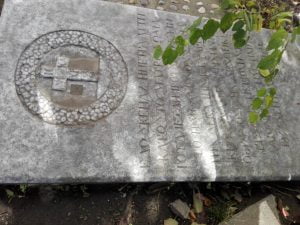
At one time, the site occupied by this worship place was much wider, the area being known as a monastery ensemble. Incidentally, the archaeological dig performed in the year 1956 has unearthed a series of vestiges, among which a number of cells, but also cellars, or traces of princely courtyards. Today only the Church has been preserved, but both around and inside of it, stands out a necropolis type of site in which are included the tombs of the patrons, but also of a number of priests who served here.
Facts That Are Not to Be Forgotten
We leave Biserica Sfinţii Apostoli / The Holy Apostles Church with the thought to head toward the Mănăstirea Mihai Vodă / Prince Michael’s Monastery, except that, on our way, another absolutely wonderful place is rising: Biserica “Adormirea Maicii Domnului” / “The Assumption of Mary” Church — Sapienţei.
And, as December is getting closer, the month in which the Romanian Revolution took place, it’s time to remember those people who really fought against the Communists. And one of them was Reverend Constantin Sârbu, to whom we owe the preservation of this small Church on 5th Sapienţei.
Unlike other churches in Bucharest rising up loftily among the buildings around them, Biserica “Adormirea Maicii Domnului” / “The Assumption of Mary” Church discreetly carries on with its life behind an immense garden. Even now, when nature has gotten into hibernation, the jaundiced foliage protects the tiny church.
Patronaged by Iordache Kreţulescu and his wife, the worship place was under the care of Olimpia Emanoil Lahovary. At the entreaty of the latter, the inside of the church has been painted by the very Gheorghe Tattarescu, a great deal of the works of the Artist being preserved even to this day. Here we discover Tattarescu already come to his twilight years.
This Church is also linked to the Brâncoveanu Family, Safta Brâncoveanu, the daughter of Constantin Brâncoveanu, being none other than the wife of High Steward Iordache Kreţulescu.
After the death of Olimpia Lahovary, the Church was taken over by her heirs who lent their properties to the Holy Synod. This way, the Church on Sapienţei got to be an oath house.
Subsequently, as the chapel was received by the Patriarchy as a donation, the latter turned it into a warehouse, ignoring the request of the Donor, who has expressly requested that the abode be open to the public.
Over 40 years this Church lay in oblivion. The one who gave it back to the believers is Reverend Constantin Sârbu. Come back from the Communist jails, this Father, about whom it is said that he was one full of grace, made immense efforts to salvage the tiny church.
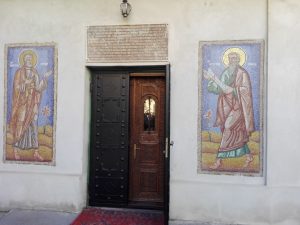
Father Sârbu was punished by the Communists on grounds of belonging to the religious-cultural movement developed around “Bariera Vergului” Church, a worship place that the Communists did not accept because of its dimensions. The Father spent eight years in the Communist Jail at Aiud, and two further years in Bărăgan Plain. And when released, he was given the poorest of the chapels in Bucharest. Here is rising today Sapienţei Church.
The history of this little church is linked to another persecuted person of the Communist regime. Father Constantin Voicescu served the Church until 1997. He arrived here in 1976, but prior to that, he spent rough years in the jail, being sentenced in 1958 to forced labor for life. He belongs to the “Târgu Ocna mystic-legionary batch.” He escaped prison following the General Amnesty Decree of the political detainees, issued in 1964.
Once gotten out of prison, he dedicated his life to the Church. This is how he got to take steps between the year 1985 and 1986, for salvaging the Sapienţei Church from the Communist demolitions. He lived seven years after the fall of Communism, and all this while, he waged a real fight to show the immensity of the crimes during the Communist regime.
Our journey into history doesn’t stop here. Across the road from Biserica “Adormirea Maicii Domnului” / “The Assumption of Mary” Church – Sapienţei is rising today Mănăstirea Mihai Vodă / The Prince Michael Monastery, about which we will speak in another article.

Author: Ștefania Enache
Photo: Corina Gheorghe