
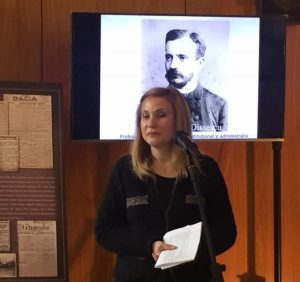
 University Lecturer Florentina Niţu, the Dean of the Faculty of History within Bucharest University, campaigns for a stronger involvement in the promoting of Bucharest, about which she says it is a city which has many stories to tell.
What is the role of heritage and cultural resources when we talk about the identity of a nation?
Nowadays, it is generally assumed that heritage and cultural resources represent the identity of a community, no matter if we speak about a greater or smaller community, of a nation, or of a village. Therefore, the heritage, meaning those values handed down from the ancestors, endorses, and at the same time individualizes, a community; it represents a cultural identity language.
What are the main directions that need to be considered when it comes to the heritage of the city of Bucharest, to keeping and preserving thereof?
Unfortunately, any great city encounters difficulties in preserving its heritage, maybe also due to the fact that we’re talking about a large community, very miscellaneous in its background, and for which the identity that heritage offers is rather vague and for this reason, perhaps overlooked. Being a center in which the political power resided, Bucharest gathered a very diverse population, attracted from as far back as the Middle Ages by the advantages of engaging into a commerce with the political elite resident here, or by the economic and political advantages of being close to the decision-making center. These persons attracted by the Capital often preserved the cultural identity values of the community of origin, and therefore were only partially integrated to the Bucharest cultural identity values; in this manner, the responsibility related to the heritage diminished.
Therefore, I believe that the current Bucharestian community has in its DNA very diverse cultural identity values (diversity emphasized by the Communist ordinance of forced urbanization), and consequently there is no perfect overlapping and an accountability concerning this heritage of the city, handed down from ancestors we don’t know very well.
And in this manner, we get to another sensitive realm, that of education. In order to ensure the preservation and protection of the Bucharestian heritage, whether we speak of the built-up heritage (as much of it as it has survived the Communist bulldozers), or of the immaterial one (of the interwar values and traditions, for instance), there is a need for a coherent and consistent policy on the educational plane. According to my opinion, the lessons conducted in the school under the motto “Know Your Street / Residential Area / City” could be a small start. We need to assume though the fact that identity cannot be built overnight, and that lectures or billboards placed in the city will not immediately ensure the responsibility related to heritage.
Did Bucharest succeed in turning this heritage that it is possessed of into a valuable economic resource?
Honestly, I don’t believe that happened at the level at which it could be achieved. There are very good individual initiatives promoting Bucharestian heritage, but for a really profit-generating promotion, there is the need for investments that only the local administration can make.
Bucharest is a city in which history combines with modernity. How could we better highlight the heritage of the city, so we can capitalize on it to the uttermost?
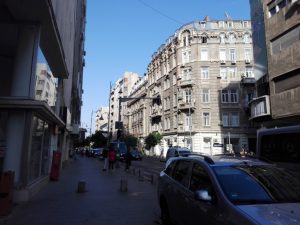
I confess that seldom it happens to me to rise up my eyes as I walk through Bucharest. Tourists, though, afford greater attention to details. Unfortunately, many buildings have their walls blackened or dirty, and suggest a lack of interest that can easily be conveyed to the onlooker.
But, since we are talking about modernity, there are fairly many modern options of capitalizing on the urban heritage: phone apps signaling interesting places or buildings, billboards dedicated to a number of monuments, urban circuits paneled accordingly, and provided with QR code (such as there are in Iaşi, for instance).
Again, I believe you can go from particular to general, namely from the involvement of small communities to the larger community.
Some time ago I’ve been working on two projects of tagging the memory of a number of places: one of them targeted the Simu Project, whereby a number of billboards were set up containing text and images about Simu Museum, a building demolished by the Communists, in the area located behind the former “Eve” shop, on Magheru Boulevard.
Every time I pass through the area I notice sadly the gradual destruction of those billboards signaling to the inhabitants of the area and to the passersby that in that place there was a piece of Bucharest destroyed by the Communist bulldozers, a building in which a lover of beauty, Anastase Simu, gathered artworks that he desired to share with others.
Another place in which there was an attempt to tagging the memory is Parcul Regina Maria / Queen Mary Park: in that place were installed panels with images of the Queen, and with short info or significant quotes.
There is an exceptional project of bringing back into our attention the Uranus residential Area, destroyed by the project of constructing the House of People, and this kind of projects can be replicated.
The former Jewish residential area, in the “Unirea” area would deserve attention, where traces of old Bucharest can still be seen; short informative panels can be installed at the “Unirea” Subway exit, or phone apps can be devised signaling the presence in the close vicinity of a number of interesting buildings preserved from another world, from another Bucharest.
These are themes that can cause the community to stand in solidarity as far as valuing its roots, in order to then come back to the heritage that has been saved, and contemplate projects of capitalizing on that. And I believe that the young people are sensitive to this kind of forms of conveying the information. Still, I strongly believe that once the love and respect for the Bucharestian heritage is lacking, any promoting solution will fail.
What are, in your opinion, three places that any tourist fond of history, getting to Bucharest, should not miss? Why?
I believe that a tourist fond of history should by all means go through Calea Victoriei / Victory’s Avenue. He will find here a whole bunch of stories told by buildings still preserving with dignity the traces of the interwar beauty.
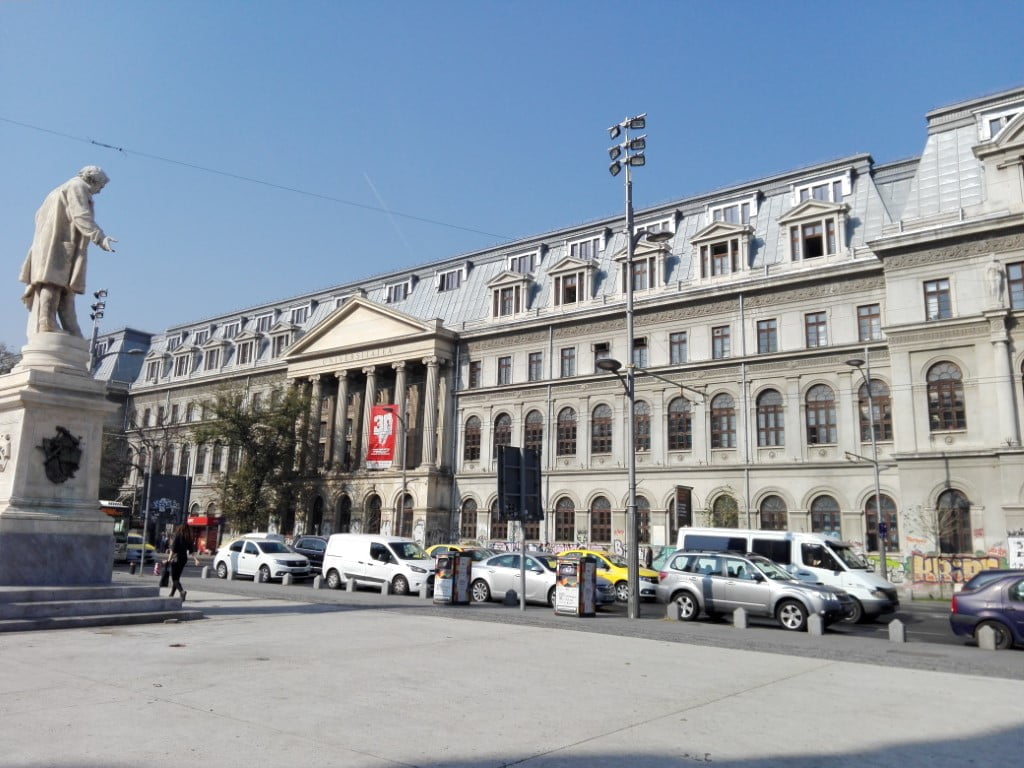
And he should also see the University of Bucharest, since it is the place to which were linked the desires and hopes of many generations of ancestors (beginning with 1848) who built the Romanian state. And also, since here were formed the Romanian elites.
I would say that he could see the Palace of the Parliament, with the hope that they will be able to get over the impression of the grandeur of the construction, and will feel what are the effects of a totalitarian regime over the people’s lives.
If you were to pick three Museums in Bucharest to visit, where would you stop over?
Truthfully, I’m recommending to everyone the Museums within the network of the Museum of the City of Bucharest; they are modern Museums, the buildings housing them are beautiful and have the fragrance of the interwar city, and the people there are very warm and friendly. And I also enjoyed a lot the Museum of Recent Art, and the National Museum of Maps and Old Book, respectively.
Bucharest is possessed of a fairly generous network of Museums. How could we bring these Museums into the spotlight, so that tourists may get to see them, to discover them?
I believe that the living museums succeed to promote themselves as well as they are able through their own websites and by various social media channels. What can give force to this promotion is the collaboration with the tourist agencies, so that these would include in their portfolios recommendations of visiting the museums. Another way of promoting is the one of virtual form of presentation. Not in the least, the souvenir shops could have a more attractive offer, beyond books and postcards.
Going through the Old Center, fairly many organized groups of foreign students can be observed who decide to visit Bucharest. Can we say that in recent years Bucharest succeeded to register itself on the world-wide tourist map?
I don’t realize whether or not Bucharest registered itself on such a map, but an increasing interest of the tourists can be seen with the naked eye, at least in the area of the Old Center or of the University. But the signage is rather poor; more often than not the tourists come out of the University Passage disoriented, searching for various routes. It is not enough for there to be the interest from the part of the tourists; we need to maintain and develop this interest.
Is historical tourism an alternative to Bucharest?
I believe that historical tourism is an alternative of visiting. Bucharest has stories to tell, and people love stories, no matter their age, gender or race.
The Faculty you lead prepares the future generations of specialists in the field of history. Why do the young people should turn to the education institution you represent?
History is a discipline that doesn’t go obsolete, I would say. Why History in Bucharest? Because we are a part of a University with international recognition. But especially because our students learn to “read” beyond the written text, to form a critical thinking, a thinking that would allow them to be free citizens. And, not coincidentally, just next to us there is the balcony of the University and the University Square, which are landmarks of our post-Decembrist democracy.
Are the young generations preoccupied by the preservation of the heritage and by finding solutions for a better capitalization on it?
The Faculty of History includes in its educational offer a Master program in the field of heritage, beginning with the year 2016. The two generations of graduates of this program entitle me to be optimistic concerning their preoccupation for the heritage. The constructive dialogue with their professors can only be conducive to solutions of capitalization suited to the young generation. The projects that we run allow the students to get involved, to learn to become part of a message of protecting and capitalizing on the heritage.
What is the role of the history specialist in modern society?
The specialist in history is a man of the citadel; he gets involved in its proper functioning, as much as he is able, forming in his turn specialists, and making an honest research that he would bring to the attention of the interested public.
What steps should be taken, at an administrative level, so that Bucharest would re-become Little Paris?
I don’t know whether Bucharest must re-become Little Paris. Perhaps there is the need for the city to seek for itself an identity that would be assumed by an increasing number of its inhabitants. What I do know is the fact that Bucharest has an important cultural potential, and that this must be cultivated and promoted at a level both institutional and individual.