


 The elegant Washington Street proceeds out of Dorobanţilor Boulevard and goes all the way to Piaţa Victoriei / Victory’s Square, the other end meeting a small plaza formed by Paris and Argentina Streets, small plaza from where you can see the majestic building of Palatul Victoria / Victory Palace.
The traveler on foot on Washington Street can admire spectacular houses. Actually, all the edifices in this part of Bucharest, also named “of the capitals area”, are fascinating for the tourist fond of architecture.
Emerged as a result of the Filipescu Family’s real estate being parceled at the beginning of the 20th century, the neighborhood has a development similar to the Ioanid Area. Those who wished to purchase a land plot in Filipescu Park in order to erect a building were compelled to observe a number of strict rules; for instance, the height of the building should not have exceeded 13 meters. By observing these rules, the result was a neighborhood with large sidewalks and rich vegetation.
A String of Historical Monument Buildings

On Washington Street, at Nos. 9, 30 and 32, you can admire historical monument buildings in B Category. The mansion at No. 9 has been the residence of the great Romanian musician and choral conductor, a corresponding member of the Romanian Academy, George Georgescu (1887-1964). A good friend of George Enescu (1881-1955), under the influence of Arthur Nikisch and Richard Strauss, great musicians of that era, George Georgescu chose the art of choral conducting. Changing the cello with the baton, in the year of 1918 he stood on the podium of the Philharmonic in Berlin. With a schedule including “The Pathetic Symphony” by Tchaikovsky, Edward Grieg’s “Piano Concerto,” and the symphonic poem “Till Eulenspiegel” by Richard Strauss, he had a remarkable success. This was the commencement of a bright career.
In Romania, the edifice he lived in was built according to architect Duiliu Marcu’s plans (1885-1966), the same one who designed, besides other famous edifices in Bucharest and in the country, also Palatul Victoria / Victoria Palace, which is now the headquarters of the Government of Romania and a landmark for the traveler on Washington Street.
Topographically, the street is possessed of a certain symmetry, meaning that toward the extremities, it intersects: at one end Argentina Street, and at the other end Brasil Street, thus complementing the American resonances of the arteries’ names in this area. London, Rome and Bruxelles Streets cross Washington Street as well, thus outweighing the transoceanic influences.
Stylistically, the edifices keep the specificity of the area, adopting the neo-Romanian style, but also the neoclassic one, as if justifying the designation of the street, taken from the capital of the United States, in which the neoclassic, Georgian, Gothic and Modern architectural styles are reflected in the important edifices in Washington D. C.
The Doicescu Mansion
At No. 7, we find a gem with a Mediterranean air. The mansion has been designed by Architect Octav Doicescu (1902-1981). The well-known Romanian architect has also designed The Polytechnics in Bucharest, the building of the Romanian Opera House, the Mioriţa Fountains on Kiseleff Avenue, within the Carol Park.
A unified and compact rectangular cuboid, the edifice is possessed with a hipped roof, less than 30 degree-slope, and a tile covering, volumes evidenced by protuberances, porticoes, bow-windows, terraces or balconies, arcades and intersection ribbed-vaults. The metal latticework at the windows, and the Balkan weave – of Oriental source – of the wood utilized for gutters, handrails, shutters and corbels, contribute to the general eclectic note of the street.
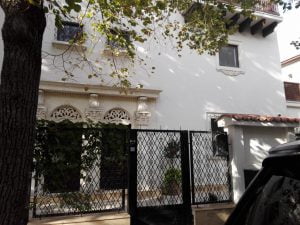
The house on 7th Washington, also known as Vila Doicescu / Doicescu Mansion, has just undergone a comprehensive remodeling. The specialists who intervened on the edifice had a difficult mission because of its value and the elements distinctive of the Doicescu era. The greatest challenges intervened in the case of remodeling the interior, because a perfect harmonizing was imposed between the initial architecture and the needs of nowadays life. The façade of the mansion impresses by the decorative metalwork enriching the windows, but also by the balcony with a rustic air.
In the mansion at No. 19, “at corner with London Street” lived in the latter part of his life the Academician Mihai Ralea (1896-1964).
Going past the mansion at No. 19, that Washington shares with London, the street continues its shady and elegant course, crossing Bruxelles Street and the bright Brasil Street. And thus, we get to the intersection with the agglomerated Dorobanti Boulevard, that represents a surprising “comeback” to the usual fuss of the capital of Romania.

Author: Ștefania Enache
Photo: Corina Gheorghe

)