
 Bucharest is not only a city in which one can discover the history of architecture by roaming the streets strewn along with heritage buildings. It is not only a city in which young people can find a plethora of places they can have good time in. It is not only a city in which the thirst for culture is quenched by spectacular museums hosting unique showpieces. Bucharest is a complex city in which even the most demanding of tourists finds his place. Bucharest is the ideal city in which the tourist fond of science and technology has at his disposal a variety of opportunities that can satisfy his need for exploration.
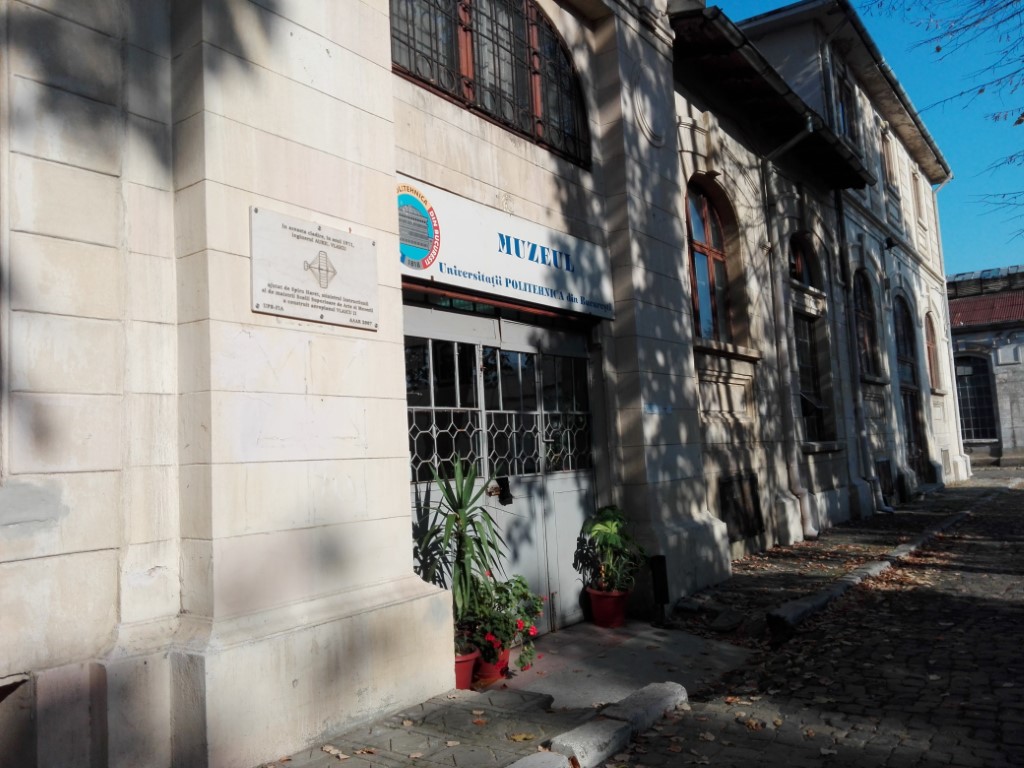
For this category of tourists, today we have chosen to visit Bucharest Polytechnic University Museum. Beginning with the year 2003, one of the most famous Universities in Bucharest has, again, its own museum. Actually, it is a Science and Technology Museum in which even the person loving in the least exact sciences gets to discover things that can capture his attention.
Arranged in a space that is a bit hidden, this Museum is a real “Aladdin’s Cave,” in which one can find unsuspected treasures, under the care of a team of hearty people, eager to meet guests with whom they can share the achievements of the Romanian School of Engineering, achievements that they refuse to let oblivion fall upon.
And visitors don’t need to roam for too long. Bucharest Polytechnic University Museum is located in the old campus of the National School of Bridges and Roads located next to the North Station, on 132 Griviţei Avenue. This place is known today under the name of Polizu Campus of The Polytechnic University of Bucharest. The Museum is housed in M Unit. And those who want to cross its threshold should know that the entry is free.
We offered all these details in order to silence the devil’s advocates who will comment that the museum is all too hidden and it’s hard for them to get to it.
And you must believe us that it’s worth tearing out a couple hours of your time to discover this place in Bucharest. Besides the reward he can get for viewing a number of unique works worldwide performed by the Romanian engineers, the visitor can live or re-live a real student atmosphere.
The Museum Telling the Story of the Engineering School in Romania
The story of the Museum is intertwined with the one of the Engineering School. None of the institutions has had a linear path; but every time the situation demanded it, they offered society the best solutions.
The first engineering classes in the Romanian language were brought in by Gheorghe Lazăr, around 1818. He had the support of the great boyars of the time, as a result of their need for specialized engineers to measure up their estates. As the school developed, novelties came in. Documents show that, on December 26th 1884, the French Architects Lecomte du Noüy and Cassien Bernard made public the blueprints for the National School of Bridges and Roads. The latter of these architects is also the one who drew up the blueprints for the Palace of The National Bank of Romania on Lipscani Street.
The blueprint of the French Architects underpinned the construction of the edifice located now on Griviţei Avenue. The Architects designed an amphitheater, a number of classrooms, Physics, Chemistry and Mechanical Tries labs, drawing rooms, a library.
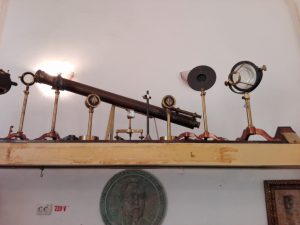
The person who dedicated this school was the very King Carol I. The event took place in 1866. Interestingly, within the building we will also find the “Museum and Collections Hall,” as the Museum was designated at the time.
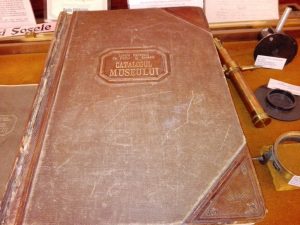
Documents reveal that 8000 gold pieces were spent for equipping this Museum. Professor Gheorghe Duca, the School’s Principal, ordered no less than 867 instruments, as well as didactic and scientific devices, from “E. Ducretet” Company (of scientific equipment) in Paris. The 867 objects purchased by Professor Gheorghe Duca constitute the first part of the treasure The Bucharest Polytechnic University Museum hosts nowadays too.
Amongst these showpieces, there is the Yardstick (silver in brass) in a wooden box, with certificate of verification, made up by Precision Instrument Company “E. DUCRETET & CIE” IN PARIS.
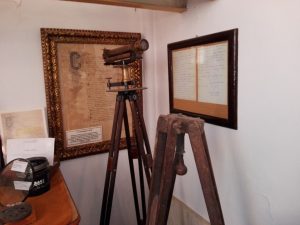
Very close to this Collection is displayed the theodolite under „STARKE AND ROMMERER” brand, used by Anghel Saligny’s team of engineers in designing and constructing Cernavodă Bridge. The piece dates back to 1880. Beginning with the discovering of this showpiece, the visitor will find out that Cernavodă Bridge was dedicated in 1895, that the works for its performance took five years, and at the time it was opened to traffic it was the largest bridge complex in Europe and the third in the world. The construction also brought two technical novelties: the utilizing of the cast (soft) steel instead of the puddled, and of the beam system with lattices in console (Gerber beam).
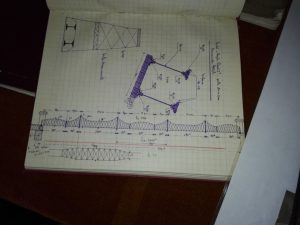
Entire generations of students have studied this masterpiece of the Romanian Engineering School, and in the Museum, we find notebooks containing the nib-drawn sketches of the bridge, including detailed frame profiles.
Going further, we have the opportunity to see on display a series of personal objects and pictures of the age during which Engineer Ștefan Georgescu Gorjan led the works of performing the famous masterpiece of Constantin Brâncuși: Endless Column.
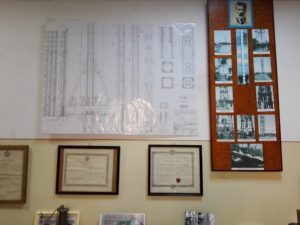
Gorjan and Brâncuși knew each other since their childhood, being friends. When the well-known Romanian Artist received the proposal to construct the architectural complex at Târgu Jiu, the one who came up with the technical solution for the Endless Column was Engineer Gorjan. In fact, at the time, he occupied the position of Chief-Engineer at Petroșani Central Workshops, where the units of the Column were cast in iron. As is it is known, the model for these units was made by Brâncuși in linden wood, and the Column’s assemblage was completed November 1937, while its brass plating took place July 1938.
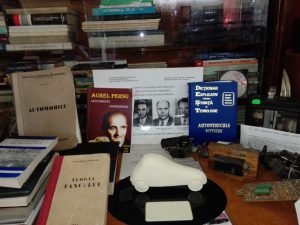
The museum unveils itself to us with every single showpiece, following as it were the succession of developing and detaching from one another of the engineering specializations. In this museum we can admire the model of the world’s first automobile with an advanced aerodynamic profile and with the wheels integrated in the car body. It is the project of Engineer Aurel Persu.
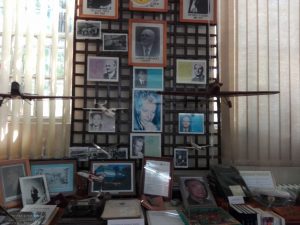
We also have the opportunity to discover the control desk of the first power plants. Walking further on, we get to the aircraft specialization, where the Romanian Engineering School produced pioneers too, and we can admire airplane models, as well as personal objects belonging to Aurel Vlaicu, Traian Vuia, and Henri Coandă.
There is no way we can ignore specializations such as automation, chemistry or computers. In this Museum we can find out about the beginnings of the IT era by admiring computing equipment with their gigantic dimensions compared to the dimensions of the ones nowadays.
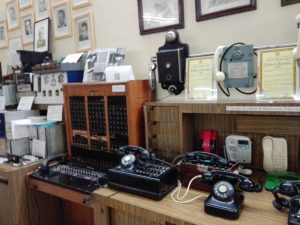
On these premises we also find collections of the first telephones, first models of TV-sets and we leave with the promises of the curators that as soon as possible we will have a collection illustrating the evolution of mobile phone models.

Author: Ștefania Enache
Photo: Corina Gheorghe