
 I determined fairly abruptly to stop my stroll on Calea Victoriei / Victory’s Avenue, and get into the courtyard of Cantacuzino Palace. The gates were wide open and it was as though a power unbeknownst to me pushed me to go past them and head toward the building. I bypassed the two lions standing guard at the doors and I hurriedly climbed up the stairs toward the first of the rooms. From somewhere ahead of me, “The Romanian Rhapsody” was calling me as if to enter its world, the world of George Enescu.
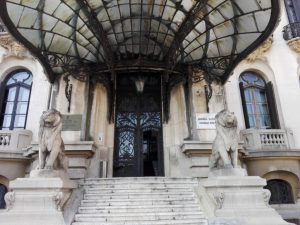
In the sound of the vibrant music I allowed myself to be led through each of the rooms open to the public in Cantacuzino Palace. The experience was unique, and all the time I’ve had the sensation that, from somewhere, from another room, the very Enescu is going to show up.
Amongst his belongings, I’ve constantly felt his presence and I was expecting to see him in front of me, in his perfectly tailored tuxedo, and with the white gloves covering his hands.

Cantacuzino Palace houses “George Enescu” National Museum, and somewhere behind the building there is also the Composer’s Memorial House. For the time being, the public only has access to the rooms in which the great Musician’s personal belongings are on display, The Memorial House going through a period of remodeling.

But even so, the experience of seeing “for real” glimpses of Enescu’s life is unique and affords you the opportunity to discover the image of this sublime personality even beyond his musical masterpiece.
Even though the stately building on Calea Victoriei / Victory’s Avenue used to be owned by the Cantacuzino’s, Enescu’s mark is much stronger than the mark of any family of aristocrats. The Palace’s massive walls have George Enescu’s energy imbued in them.
George Enescu Is Waiting to be Discovered

While admiring the Museum’s exhibits, I had the chance to avail myself of the presence of Mariana Petrescu, the Communication Director of the institution. The passion with which she spoke to me about a couple of important episodes in the life of the great Composer caused me to wish to find out even more. So, she promised me that the material in question is but one of a series dedicated to the Musician.
In a period during which the young generations suffer because of not having patterns they can relate to, Enescu can constitute such a model.

George Enescu was not only a composer and musician of genius, but also a remarkable man from whom we can learn tremendous life lessons.
But let’s return to the Museum, where we noticed a lot of tourists coming over. Some are from Romania, from outside Bucharest, but most of them are from abroad. Even though my visit took place on a Thursday, visitors would enter through the Museum’s doors all the time. And what greater joy there is than seeing tourists from Italy who want to discover Enescu, ladies from Germany who do the same thing, or young people from Great Britain who heard about Romania precisely because they are fond of George Enescu’s music.
So, I propose that we would discover George Enescu together. Today we will do it by means of a number of his belongings, items speaking volumes about the personality of the great Artist and that you can admire if you go visit “George Enescu” National Museum.

The presentation below does not claim to produce a leaderboard, but simply represents a bringing into the foreground of some of the Enescu’s precious things. Both Mariana Petrescu and Curator Silvia Costin offered me support in my mission of selecting these items in the Museum.
By introducing these items to you, I wish nothing else but convince you to go to the Museum and thus you will have the opportunity to select, on your turn, other exhibits that you would speak to your friends about.
Items Bearing the Mark of the Great Composer

I will start out my presentation with the desk and chair that used to belong to the Artist and that were brought to Bucharest from his last residence in Paris. The desk is distinguished by the fact that it bears a famous signature, being one of the pieces crafted in Emile Galle Workshops. The Maestro’s handiwork, known all over the world for his style possessed of strong accents of Naturalism, is spectacularly evidenced in the case of the desk at which Enescu composed. The wood is decorated with floral motifs, as if ennobling the desk and affording it a unique air. This is performed out of wood marquetry of various essences and is embossed with leather.
In its turn, the armchair is one of handicraft, being crafted at the end of the 19th century, in France. The items virtually transfer us into the intimacy of the great Composer and afford us an idea about his work corner.

On the desk, the visitors have the opportunity to admire the sheet music, in facsimile, of the Opera “Oedipe,” an Opera that George Enescu composed during more than ten years of work. The exhibit is a special one, since it is a photocopy according to the original manuscript.
Concerning this famous sheet music, there are a number of stories in circulation. Some of them make reference to the fact that the Maestro, for fear of losing his original Opera, carried it constantly upon himself, in a shabby leather briefcase.
“Oedipe” had its Premiere in March 1936 at Paris, on the Garnier Stage, and when he completed it, the Composer dedicated it to “the princess of his heart” – Maria Rosetti-Tescanu, the one we also know today as Maruca Cantacuzino. We’re talking about the Artist’s great love, who also became his wife toward the end of his life.

We will turn our attention toward another special exhibit. We are talking about the Maestro’s tuxedo. It’s the stage suit that George Enescu wore in numberless occasions. The beauty and elegance of the tuxedo bear witness to a life dedicated to stage, to music. This outfit virtually brings in front of our eyes the complete musician, who could not conceive showing up in any other way before his audience. Within the museum, the tuxedo is one of the special items, since it belonged to the Maestro and presents him exactly the way he was, statuary, stately.
On the tuxedo’s collar, the bystander may notice the Legion of Honor Rosette, an accolade granted to George Enescu by the French state, in March 1936, on the occasion of the „Oedipe” Opera premiere. The tuxedo is part of the donation made to the Museum by Maruca Cantacuzino.
The suit was always supplemented by a pair of gloves of an impeccable white. As we all are aware, Enescu never insured his hands, as today’s world-class violinists do. However, he did protect them, regardless of season, by means of the gloves.

Very close to the place where the tuxedo is displayed, there is also the academician’s suit of the Composer. By observing this item, you can’t stop picturing Enescu in his posture of prominent personality of the Romanian culture, coming as a natural completion to the posture of the musician much in demand in tours, but who made huge efforts to appear impeccably in front of the spectators.
The Curator who is my host also stopped in front of an item received as a present by George Enescu in April 1946, from Moscow Philharmonic Orchestra of. We’re talking about a cup made of silver and crystal, a thesaurus item, produced in the Russians workshops. 1946 was the year during which the Composer has taken a successful tour in the Soviet space, and the cup received as a present speaks to us about the fact that Enescu succeeded to assert himself in all the circles of the time.

The event afforded him meetings with great music personalities, but at the same time stirred up a series of controversies in the political space as well, the visit to Moscow of the great Romanian Composer being presented in a light that deeply disappointed the Artist. He went into the Soviet space only to make music, and his visit didn’t have any political connotation. The evidence of the fact that Enescu remained faithful to his principles consists precisely in his decision to choose the exile in the very same year, and to never return in the country.
In order to discover one of the very important persons in the life of Maestro Enescu, we will move on into another room of the museum, where on one of the walls reigns Elena Bibescu’s portrait. The picture bears the signature of Painter Henri Martin, and presents to us Princess Bibescu exactly the way she looked toward the end of her life, when the illness was plaguing her body.

„Vice-Mother,” as Enescu used to call Elena Bibescu, played a major role in the Musician’s career, being the one who facilitated to the Artist the launching into Paris’ cultural life.
We will conclude our itinerary in front of Enescu’s statue, an exceptional artwork performed by Gheorghe Anghel. It’s a very successful portrait, in which the musician is presented at the age of his adulthood. Looking at his countenance, it’s as though you expect him to bow over his music stand and to conduct his orchestra.
This is only a small fragment of the world of Enescu, a world in which I invite you also to enter and to discover other stories in the life of the great Composer.