
 The tourist among the vestiges has chosen to lead us today to the paradise of the rural world, where the world of the Romanian village is exposed in all its splendor. We will walk around “Dimitrie Gusti” National Village Museum in Bucharest, the place that highlights, in an absolutely superb way, the tradition of this people.
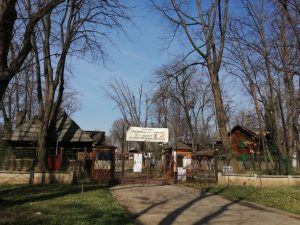
The museum has a surface of 14 hectares, and the built patrimony, which constitutes an original synthesis of the life of the Romanian village, includes 143 complexes and 392 monuments.
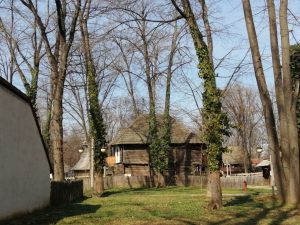
The Village Museum also houses over 60,000 heritage objects and over 250,000 archival documents. All these elements, gathered in one place, form the most important monograph of rural life on our lands.
Paradise of rural life
As soon as spring gives the first signs of life, the alleys of the Village Museum are filled with the scent of flowering trees. A visit to this museum is the best way to break away from the turmoil of the city and to throw your whole soul into a “wonderful grove”, as you can only find in the stories of Lizuca.
When you choose to visit this place, it is good to start early in the morning, because otherwise you will not have time to see all the “wonders” that this museum makes available to the public.
Even at the first hour after the museum opened, the tourist among the vestiges passed through its gates and ventured into the paradise of rural life.
The amazing world of the village
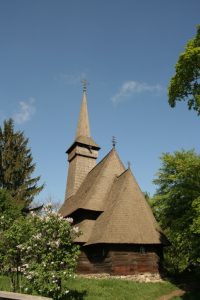
Lost in the alleys of this huge open-air museum, the tourist among the vestiges first stands in front of an amazing building that rises to the sky. It is the Dragomirești Church, from Maramureș County, moved in the museum’s premises by the team of Professor Dimitrie Gusti in 1936.
The place of worship dates from 1722, when it was erected on the site of another church that the Tatars burned in 1717. It is not a church similar to those with which the Christian is accustomed to meeting on his pilgrimages. The construction in Dragomirești respects the specificity of the architecture from Maramures, being built from spruce wood beams. The technique used in the construction of this edifice is similar to the one that the craftsmen from Maramureş use in the houses and the annexes of the peasant households.
The church is amazed by its open porch, which rests on wooden carved pillars, but also through the roof “with double “lap” and fast slopes, specifically the Nordic Carpathians”.
The place of worship seems to twitching to the sky, and from its height of 35 meters dominates the whole area.
Also surprising is the interior decorated with popular motifs and painted with a series of scenes that reflect glimpses of popular beliefs.
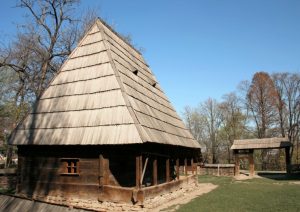
And since we mentioned the architecture from Maramureș, the tourist among the vestiges continues his journey and stops in front of a household in the village of Berbești, on the Marei Valley.
The assembly dates from 1775 and includes the dwelling house, but also a series of household annexes (shed barn, sheep shelter, corn basket).
The Berbești household was brought to the Village Museum in 1962, when it was rebuilt piece by piece.
The construction is representative for the material and spiritual culture from Maramureş, being valuable and due to the craftsmen’s signature, signature on the beam of the house: “Pașco de pe Sălaje”.
The viewer who discovers the house finds important information not only about the way the constructions were made in Maramureș, but also about the way of life of those who lived in these households.
The house consists of three rooms: the sleeping room, the hallway and the food pantry. All these rooms are lined up along an open porch. The porch rests on wooden pillars joined together by arches. In fact, the entire construction is made of wood planks carved from oak. The living room is so divided that it gives the impression of a very generous space. The furniture is a simple and functional one: a bed arranged on one side and benches placed at right angles. A table surrounded by chairs occupies the center of the room. An important space is allocated for the fireplace, which has an oven and “prichici”, a place specially arranged near the stove so that in winter, in this space, the children or the elderly can rest.
We stay in the area, to discover a household in the village of Șurdești, Lăpușului Country. The 18th century construction was moved to the Village Museum in 1967.
Like the Berbești household, it gives us a lot of information about those who lived in this house. Clearly it is about a family of peasants with a certain status considering the annexes: the shed, the grain store, the pig shelter, the stable and the dry fruit plant.
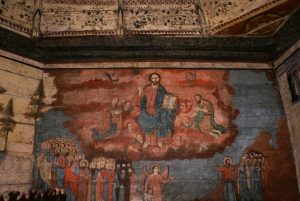
We move to Răpciuni village, from Neamț county, the place from which comes the church dated 1773, which is located today in the Village Museum. The place of worship was brought to Bucharest in 1968, thus being saved from a possible demolition caused by the relocations that were made on the Bistrita Valley to make way for Bicaz Hydropower Plant.
Răpciuni church was erected in the time of Grigore Ghica voivode, the year of construction being carved in wood, with Cyrillic letters.
The edifice of worship, besides the information related to the religious life of those times, also offers us relevant data on the events that marked the lives of the inhabitants of Răpciuni. In the porch of the church are carved with Cyrillic letters events related to heavy winters or droughty summers, but also about the locust invasion of 1847.
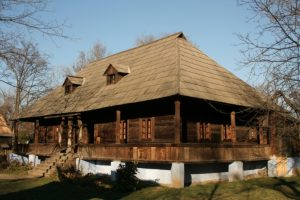
The life from the heart of the settlements on the Someșul Mare Valley is best highlighted by the household in the village of Șanț, Bistrița – Năsăud. The house respects the specific of those from the border villages, having a hallway, flanked by two large rooms, one for living and one for guests. In the first of the rooms, the furniture consists of only bed, table, bench and cupboard for dishes. Instead, in the second room, the furniture is composed of two symmetrically placed beds, table in the middle, bench with backrest, cupboards for dishes, hope chests and painted hangers. The color that dominates everywhere is red.
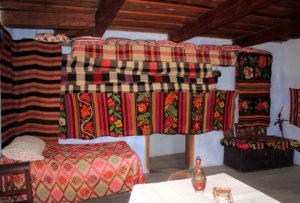
The house, built of beams, on a high stone pedestal, with a three-sided porch, was built in 1896 and arrived at the Village Museum in 1936.
We continue our journey and arrive at the house of Moş Văsâi of Ion Cobuţ in the village of Moişeni, Satu Mare county. The one who transferred, in 1936, this household to Bucharest was Gheorghe Focşa himself, director of the Village Museum between 1948 – 1978.
From the beginning, at the house of Moș Vasâi it impresses the entrance to the household, which is made through a twigs gate. In the courtyard, besides the dwelling house, we find also a series of annexes: barnyard (pantry), a barn (stable), a henhouse and in a corner, a tall prayer (guard cross), with ornaments in relief.
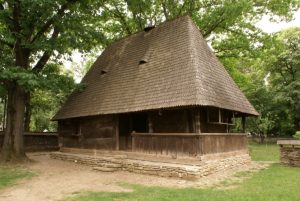
Unlike other houses in the rural area, raised only from wood, the house in Moișeni rises on a foundation made of river boulders and brick.
Right at the entrance of the house is a massive oak door, provided with a secret wooden lock. Inside objects send us back in time and remind us of the simplicity of life in the country.
About the life of the peasants from Alba county we can find out if we visit the architectural ensemble Sălciua de Jos. The house also has a pantry, and the construction was erected in 1815 and was brought to the Village Museum in 1936. The material used was pine, carved on four sides, and the foundation is made of stone.
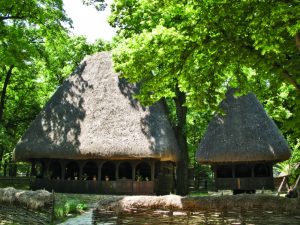
In the case of this house, the ratio between the walls and the roof draws attention. The climate in the area forced the craftsmen to find solutions to protect the houses from the heavy rainfall, so the roof has impressive dimensions, being three times larger compared to the walls.
We move to Fundu Moldovei, in Suceava, to see a farm in the area of Campulung Moldovenesc. Thus, we will discover how people used to live in the mountainous localities of Bukovina. The house dates from 1901 and is noted for its complex system of heating and food preparation.
The living of the Lipovan communities is reflected by the household in Jurilovca commune, Tulcea. The construction from 1898 was transferred to the museum in 1963.
Unlike the households presented so far, the one in Jurilovca is made up of ten rooms with different destinations. The part reserved for living comprises five rooms: two hallways, two living rooms – one for the guests – and a kitchen, all communicating with each other. The roof is made of “comb beaten” reed.
These are just a few of the treasures that the Village Museum is hiding. If you want to see the way in which people lived in the old days, to discover the life in the Romanian villages you must cross the threshold of this unique museum in the international landscape.

Author: Ștefania Enache
Photo: Corina Gheorghe