
 We have already strolled through Argentina and Brasil, so the time has come for us to explore Venezuela. We do not need a visa or a plane ticket! It is sufficient for us to enter one of the most tranquil residential areas in Bucharest, where the streets bear names of Capitals and countries. We might say that the world’s map “hid” in this area of the city, and allows us to see, one by one, the most exotic places.
Do not expect that in the Venezuela within the heart of Bucharest you would get into the paradise on earth discovered by Christopher Columbus. Do not expect to be enveloped by the orchids’ fragrance distinctive to this country in the Northern part of South America.
On Venezuela Street, there are other surprises opening themselves in front of the traveler desirous to explore the epic residential areas in Bucharest.
Just as Tirana Street, Venezuela Street radially runs through the horseshoes formed by Modrogan Street and Alexandru Alleyway, horseshoes ending up into Aviatorilor Boulevard.
Strewn along with mansions preserving the dominant eclectic style of this residential area, Venezuela Street borders the courtyard of the Ministry of Foreign Affairs.
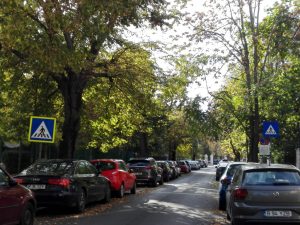
Surprisingly to some, not surprisingly at all to those accustomed with the Oriental influences of Bucharest, the street bearing a name of Latin-American origin ends up in the small and elegant Park “Khalil Gibran.”
A disc formed at the confluence of the following streets: Venezuela, Rabat, Athens and Ankara, the Park represents a socializing area, a respite to the traveler lost in the maze of the residential area with streets bearing names of countries and capitals. It could not even be different in an area reminding us of Khalil Gibran (1883-1931), Lebanese poet, philosopher and painter, one of the most well-known militants for the emancipation of the Arabic countries from under the Ottoman sway.
But, up to the Park, the street starts out virtually from the gate of the Ministry of Foreign Affairs.
At No. 6, a massive building, in a Classical style, classified in the category of historical monuments, meets us. Now the house shelters a kindergarten, and the voices of the children spending their time there fill the area with gaiety.
A little further down the street we will notice the mansion at No. 10. It is also a historical monument building, and it was built in a Neo-Romanian style, being possessed of a porch, trilobal arcades, and wooden insertions. The windows are decorated with Romanian folk motifs.
The two mansions described above are part of the specificity of the constructions from the beginning of the 20th century.
“Khalil Gibran” Park

The rich canopy of the trees, dressed in autumn colors, forms a vault of Gothic cathedral, and behind it, modern mansions, built in a Cubist style, are also hidden.
Walking along the line described by the trees guarding Venezuela Street, an almost sudden opening offers itself to you, toward an area where four streets meet. These streets do not form a classical intersection, like a cross, but like a kind of triangle, within which the circular Park “Khalil Gibran” is included.
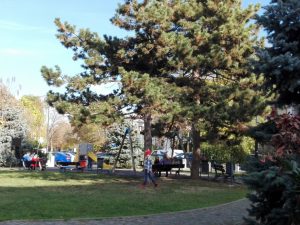
Green, skittish, with a distinctive furnishing, the Park allows both the little ones and the grown up to stop by to play or rest on their way home or from home.
When stopping over in this place, there is no way not to ask yourself who is Khalil Gibran and why does he have an area dedicated to him in the Capital of Romania? And so, you will find out that not only in Bucharest there is a place bearing his name.
If you go from Australia to Brazil, from Armenia to Mexico, from Montreal through New York or Washington, and arrive in the Beirut of the native Lebanon, or in Tripoli, you will find a statue, a street, a Museum wing, a Pavilion, or a Department of a University dedicated to the man of culture Khalil Gibran.
He is one of the great personalities in Lebanon, and thus his memory is preserved in the entire world.
Khalil Gibran was born in Bsharri, in 1883, in a Christian family. When he was 11 years old, he migrated together with his parents to the United States. But he never forgot his homeland and advocated, in his entire activity, the fulfilment of the emancipation ideal of the Arabic states from under the Ottoman sway.
Those who want to discover Khalil Gibran must know that part of his literary creations was translated into Romanian as well. There are many Romanians that relate to works such as “Poems. The Prophet. The Prophet’s Garden,” “Jesus, the Son of Man,” “Broken wings,” or “The gift of love.”
The Park in Bucharest bears his name since 2006, and was so named at the proposal of the Embassy of the Republic of Lebanon at Bucharest, which desired that the capital of Bucharest would also have an area dedicated to the memory of the tremendous personality of Khalil Gibran.
The Park completes a cosmopolitan and exotic picture for this corner of the city, where, through the resonance of the names of the avenues and the recreational area, The Balkans (Athens Street), Middle East (Ankara Street and the Lebanese Khalil Gibran), as well as Maghreb (Rabat Street) meet the remote Latin America (Venezuela Street).