
 The tourist among the vestiges will be a little distance from the center of the city and will go on a less ordinary route, but that will allow him to discover fantastic places. Ever since ancient times, people have sought water courses to establish their settlements. Bucharest is not an exception, the locality being crossed not by one, but by two rivers: Dâmbovița and Colentina. Even though the first is emblematic for the Romanian capital, few are the ones who know that the second crosses the city on a longer route, 37.4 kilometers.
On the banks of the Colentina River and on the road to Moldova, a neighborhood has been developed which, behind the huge wall of blocks of flats, hides true gems, evidence of the evolution of Bucharest.
So the tourist among the vestiges will start today to follow in the footsteps of these pieces of evidence.
The route I thought goes from Obor Square, itself a vestige, the first documentary attestation dating from the seventeenth century. In the writings of the Stelea Monastery, references are made to the “Târgul de afară” or “Oborul de vite”.
Around this place, there are all kinds of stories, many of them referring to the fact that, in the seventeenth and eighteenth centuries, here the condemned men were hanged. The execution was a public one and it was a real show.
Even after ruler Grigore Ghica banned public executions in 1823, the gallows in Obor dominated the area for many years. It was only in 1870 that it was dismantled, and in 1877, the merchants erected a stone cross in its place “to sanctify the place.”
But let’s leave these horrible stories behind and return to the value of the Obor Square.
The documents show that on the site of the old square the construction of the Obor Halls began in 1936. Three well-known architects developed the project. It’s about Octav Doicescu, Ion Fonescu and Dan Iovănescu. The disagreements between these professionals led to the abandonment of the works, which were subsequently taken over by the architect Horia Creangă, who also completed the construction.
The “Obor Central Halls” were included in the List of Historical Monuments from 2004.
To Plumbuita Monastery
The tourist among the vestiges continues his route, so he will start on Colentina Boulevard, cross the intersection with Doamna Ghica Street and stop at the intersection of this boulevard with Plumbuita Street. So far the road is straight, and on the boulevard a variety of means of transport are available: tram, bus, taxi.
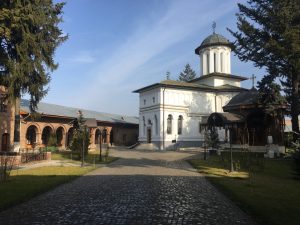
Going on Plumbuita Street, guarded, on one side by Plumbuita II Park, and on the other side by dwellings, at the end a large courtyard opens, from which the bell tower of the Plumbuita Monastery appears lofty.
The place of worship is located on a mound on the bank of the Colentina River, in the path of travelers heading for Moldova.
The place is a very special one for the history of Bucharest. The documents attest that the construction work began in the period of Peter the Younger (1559-1568). The son of Mircea Ciobanul and Mrs. Chiajna failed to see the works completed, the construction of the monastery being continued by his successors to the throne: Alexandru II Mircea (1568-1577) and Mihnea Turcitul (1577-1583; 1585-1591).
The name of the place of worship seems to have been given by the inhabitants of the area and refers to the fact that its roof has long been covered in lead plate. There are several legends that circulate around this name. One of them refers to Matei Basarab, who would have ordered the melting of the roof of the church and its transformation into cannon balls. Another one has Matei Basarab in the center, who fought between the walls of the monastery with Radu Ilias, and the fight was so fierce that the cannon balls dropped on the church melted and gave a special glow to the roof.
There are many legends, but one thing is certain namely that, since the sixteenth century, the Plumbuita Monastery plays a major role in the cultural history of the settlement. In this regard, it should be remembered that here, in 1573, the first printing press in the city was established. The project was carried out with the support of voivode Alexander II Mircea, but also of his wife, Ecaterina Salvarezzo.
The printing press from Plumbuita is the third established in Wallachia. Moreover, in 1582, here appear the first printed books in Bucharest. These are two Four Gospels and a Psalter.
It is also worth mentioning that the ruler Matei Basarab was the one who ordered the restoration of this place of worship, after the damage suffered during a fire in 1614. Thus, since 1647, the church has been rebuilt from the foundations. Matei Basarab wanted to have a construction similar to that built by Radu the Great at Dealu. This is the time when the monastery is added to the Royal House, and the walls are reinforced. Also about Matei Basarab it is said that he linked Plumbuita to the Old court through a refuge tunnel.
Forgotten most times by those who want to discover Bucharest, Plumbuita Monastery is worth visiting. Only in this way can the tourist discover a construction of rare beauty, the church building combining architectural features of a mountain type with Gothic elements and Moldavian influences.
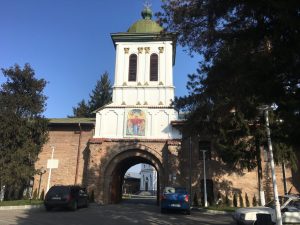
The bell tower is also emblematic, built between 1802-1806.
It is also said that during the Revolution of 1821, Tudor Vladimirescu established his headquarters in Plumbuita. Moreover, during another revolution, that of 1848, in the cellars of the monastery were closed some of those who started this event.
To the Church “Teiul Doamnei Ghika”
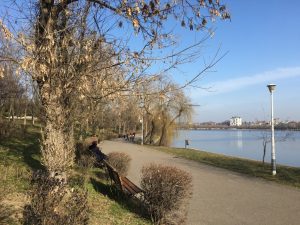
On the necklace of anthropogenic lakes on the Colentina river, in almost all the localities through which it passes, cozy parks are equipped with all the elements for leisure and relaxation. Bucharest was no exception.
The tourist among the vestiges can continue his walk from the monastery through the parks arranged near it. It can pass the Church of St. John the Baptist in Plumbuita Park, a construction of Elena Budișteanu, the wife of the architect Ion Budișteanu. Stopping at this place of worship, erected after 1989, the tourist can find out some data about the Budișteanu family, one of the boyar families who have left their mark on these places.
Starting from here, he will go on Doamna Ghica Street to the intersection with Petricani Street. He will leave behind the Ghica Tei Palace and reach the Church “Teiul Doamnei Ghika”.
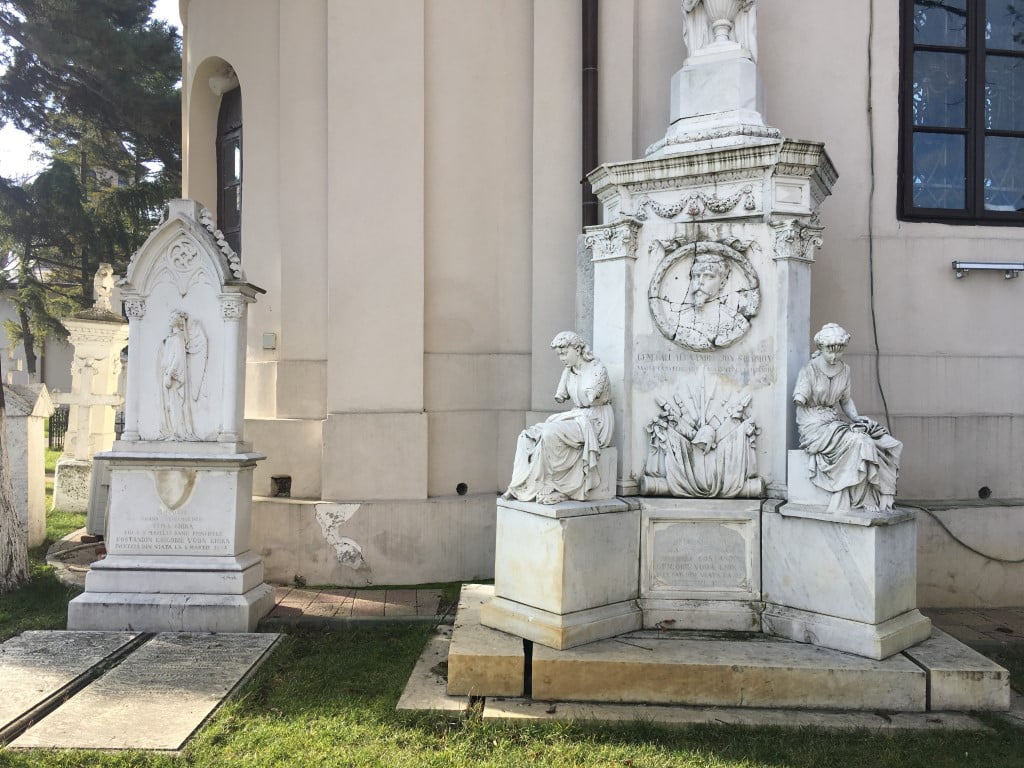
And an elegant, bright courtyard with a green lawn carpet will open in front of him, at the feet of tall pine trees among whose needles the sunbeams are playing on the marble monuments of the Ghika family.
Here he will discover an atmosphere from other times, an atmosphere that makes you expect that at any moment, in the courtyard and in the church, ladies in long, airy dresses will appear, sighing because of unrequited love.
The place of worship was erected, in 1833, during the reign of Grigore Dumitrie IV Ghika, a prominent member of this family who gave many rulers in Țările Române.
Moreover, this ruler remained in history due to many actions he took for the development of Bucharest, him being the one who gave the order for paving the streets.
But let’s go back to the Church “Teiul Doamnei Ghika”, which is said to be the only construction made by the famous master Joseph Weltz in Italian neo-classical style. In our country we can only admire a single church in this style. It is about the Church “St. Spyridon”, known as the “Rounded” Church in Lețcani, Iasi county.
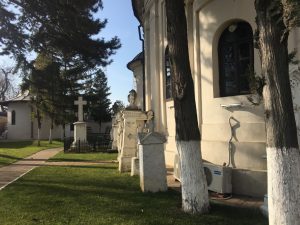
The church “Teiul Doamnei Ghika” is a building of a special beauty. At the entrance there is a porch, composed of a pediment supported on four pairs of twin columns. Also, the dome is richly decorated. Particularly important is the oil painting from the inside, resulting from a unique composition of Byzantine and Western influences. The master who made it is the Italian painter Alberto Giacometti.
The funeral assembly in the church yard represents, for its part, a true marble work of art. In fact, the whole space has a special connection, which is worth seeing.
The tourist among the vestiges remains here for the time being, but he invites you to follow him on the next trips.

Author: Ștefania Enache
Photo: Corina Gheorghe