
 The tourist among the vestiges will lead us into the universe of two personalities, who, by their actions, marked the history of Bucharest. By discovering the places in which they created, we can build an image of how they thought, how they were as humans, but also of the age in which they lived.
The universe of the painter Aman

When you visit a house, if you have the patience to listen to your heart and to understand with your mind, it speaks to you and you can learn a lot about the people who built it.
The old houses in Bucharest are real vestiges that tell us about the people of past times, about the history, but also about the evolution of this city.

One of these buildings is the one that houses Theodor Aman Museum. Built in 1868, following the artist’s project, the residence in which the well-known painter lived and created has an impressive beauty.
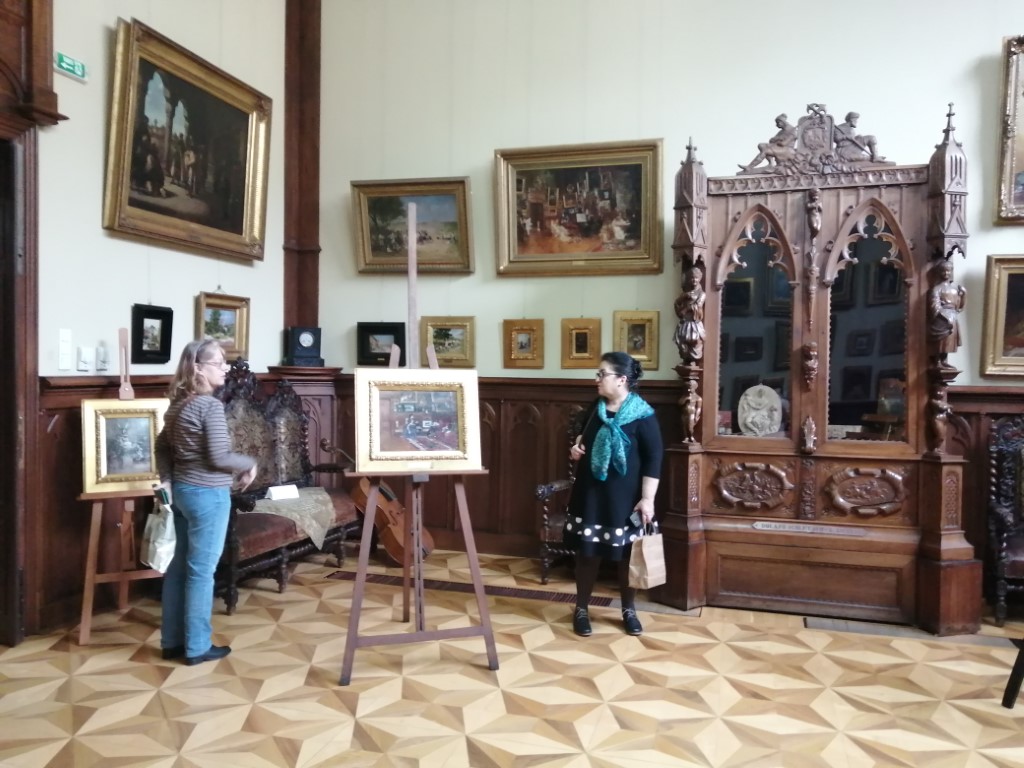
As soon as you enter this building, the impression is that you are the guest of Aman, who can from time to time appear from one of the rooms and invite you to tea. In fact, there is even a hologram of the painter accompanying the tourists on their visit to this memorial.

The artist’s spirit is felt everywhere, not just in the paintings displayed. It is felt in the furniture in all the rooms that was made by Aman himself. It is felt in the murals and stained glass windows that decorate the walls and windows. It is felt in the way the museum is organised. In fact, this is one of the oldest memorial museums in Romania, having been opened to the public in1908.
Unlike other memorial houses dedicated to those who lived in them, Aman house belonged entirely to the painter, as he was the one who designed its structure, the exterior and interior decoration, the one who established its role.

The house at 8 C.A. Rosetti Street is the first house of an artist in our country, being built so as to allow the painter to have the light necessary to achieve his creations.

The most impressive of the rooms of the building is the painter’s workshop, in which we find even nowadays the artist’s painting tools. Beside the easel on which Aman would fasten his canvas, one can also see the cello that he used to play quite often.
The house renders in an amazing way the personality of the first Romanian artist who studied in Paris.
Tattarescu’s world
Another personality of that era, the painter Gheorghe Tattarescu, presents himself to the contemporary world through the residence in which he lived.
Gheorghe Tattarescu Memorial House is located at 7 Domnița Anastasia Street. The building built at the beginning of the 19th century was bought by the painter in 1855 for 1,231 gold coins. For four decades, the artist lived and created in this house.
If in the case of Aman, we have the first house built for an artist, in the case of Tattarescu we have the only residence in the form of an inn that has managed to withstand time.
In this building, the painter who, together with Aman founded the School of Fine Arts in Bucharest, had a workshop in which his students were trained and could paint.

Works of painting, graphics and decorative art, but also objects that belonged to the artist or his family are kept in the historical memorial house near the Old Center of the Capital.
I have already written about Tattarescu’s work, when I presented some of the churches in Bucharest that he painted. He was not only remarkable for his religious works. Tattarescu left a legacy of other valuable works. Apart from the icons he painted on the walls of places of worship, Gheorghe Tattarescu liked to make portraits or paint nudes. His best-known portrait is the one that depicts Nicolae Bălcescu.
Gheorghe Tattarescu Memorial House is not open to the public, but its story is one that deserves to be told so that people can discover who the painter Gheorghe Tattarescu really was.
The tourist among the vestiges chose to present today two historical monument houses in the Capital. In this way he tried to make you look at a building beyond its walls, try to discover its history and understand the personality of the famous person who lived there.