
 The parties are over, the last confessions and scenic arrangements through the squares are tight, there are still the light installations on the great boulevards and the trees still adorned to remind us of how we have met the new decade.
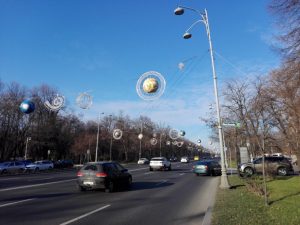
So, in the middle of January, the ride on Aviatorilor Boulevard can be a surprising turn. Turning onto Alexandru Alley, leaving aside the headquarters of the Ministry of Foreign Affairs, we are heading towards Athens … Athens Street.
A mix of styles
Those who have not met the New Year on fireworks on the Acropolis, and not only them, can admire the mix of architectural styles: Mediterranean, Neo-Romanian or neoclassical on the street bearing the name of the Greek capital.
Almost at every step we discover historical buildings: at the numbers 2, 2Bis, 3, 4, 6, 8, 12, 16, 18, 22, 24, 26. Each house has its own unique style. And the courtyards that house the cozy villas abound in small vegetation, being guarded by short fences that allow the light to reflect on the light-colored facades and give rise to an atmosphere somewhat similar to that on the streets of the city whose name it bears.
All these houses tell us the stories they shelter between the walls and urge us to admire their beauty.
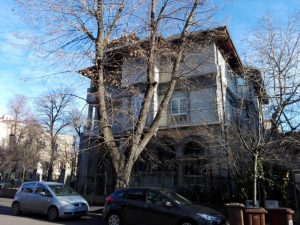
On our way we will first stop at numbers 4 and 6, where are the buildings known as “Villas of Ionescu brothers”. The houses were built according to the plans of the architect Cristofi Cerchez, at the request of the two brothers Ionescu.
The strong personality of the owners gave birth to constructions with similar and yet different styles. The villa at number 4 is one that reminds of the sweet Moldovan style, while the building at number 6 bears the imprint of the Walachian style.
It is true that, over time, the buildings have undergone significant changes, but they still retain many original elements. For example, the “elliptical arch” that frames the front door or windows, an element of folkloric inspiration, we can admire even now.
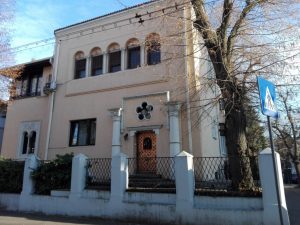
Cristofi Cerchez is one of the representative architects for the Neo-Romanian style, but in his creations he has also flirted with other styles: eclectic French or modernist cubist. Even though many of the buildings created by him, spread throughout the country, no longer retain their original grandeur, the works created by Cristofi Cerchez are real lessons for the young people who embrace this profession. Through the legacy he left us, Cristofi Cerchez remains a classic of Romanian architecture, with a major influence on the work of the professionals who admire his creation.
You can see the creators’ fingerprints
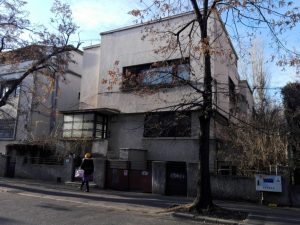
We continue our walk on Athens Street and discover other impressive buildings. In the years 1933, 1936 and 1938 the villas from the numbers 7A, 7 (Vila E. and F. Moldoveanu), respectively from number 8, were erected. The plans of the three buildings bear the signature of the architect Ion Boceanu. It is very interesting that, on one street, you will discover three houses made by the same architect. In this way you have the opportunity to discover its style, but also the influences that the owners of the respective houses had on the constructions.
If the villas from 7A and 7 are built in a modern/cubist style, the house on Athens Street number 8 (corner with Prague Street), historical monument, is built in Mediterranean style. Thus we find that the architect Ion Boceanu had a high availability for variety.
A little further, at number 22, we have the opportunity to see another building that exemplifies the Mediterranean style very well. In this case it is a house signed by architect Gheorghe Simotta. The building has a very heavy history, being bombed in 1944. It was restored later, and those who contributed to its reconstruction have retained the original style. Today, the house stands tall, contributing with the other sister buildings to the exotic note of the street.
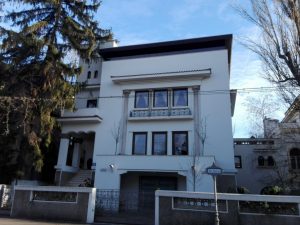
We can say about Athens Street that it is a true open air museum in which the works of many Romanian architects are displayed. For example, Gheorghe Simotta, known as the author of the Patriarchal Palace in Bucharest, has left its mark also on the houses from the numbers 18 and 20. Although he declares himself the adept at the non-Romanian style that was used at the Patriarchal Palace, the villas made by the Romanian architect on the Athens Street, the number 18 in 1827, and the number 20 in 1933, reflects the “solar essence” of his work. The Simotta brand looks great on these buildings. Thus, above the last level with horizontal windows, you can see the cornice is strongly protruded in console. From the combinations the architect made, a hybrid mixture of modernist horizontal windows with polifora windows resulted. Also, you can see how the masonry pallets, which share the window string course, are doubled by columns with ornamental or stylized capitals.
All these details give the houses a subtle Mediterranean note, in the tone of the street and in the style of many of his creations from a prolific period for the Romanian architecture: the inter-war period.