


 The Capitals in the middle of Little Paris have given us the opportunity to „travel” in different worlds and discover the uniqueness of a number of streets that only Bucharest is possessed of. Sheltered away from the city’s tumult, these places rich in spectacular buildings “compel” us, as we go through them, not to stop our exploring. Even thought they have been “christened” according to metropolises located in various corners of the word, the streets with names of Capitals form an extraordinary union in which London pushes you to see Paris, Paris sends you to Madrid, Madrid to Prague…
And, as we cannot stop this journey until we go through the last of the alleyways, we invite you today to visit together Tirana.
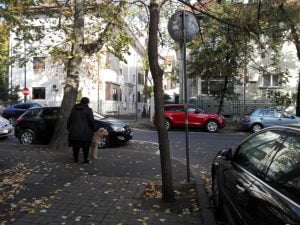
Skittish, bright, Tirana Street cuts radially the arches of the circle described by Modrogan Street and Alexandru Alley – whose ends open up on the Aviatorilor Boulevard, with a perspective toward the Heroes of the Air Monument – and continues until it meets Paris Street. The fall’s colors still decide the light-shows along the generous sidewalk and of the driveway, so it’s an ideal moment for rambling.
And we will begin our exploring with the edifice at No. 1.
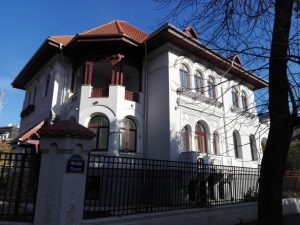
Lofty, white, the mansion at No. 1 offers itself to our sight with an arrogance born of the awareness of its beauty.
Classified as historic monument, the mansion was built during the period between the two World Wars, in Neo-Romanian style, with a simple volumetry, reminding to the traveler, as the name of the street does, that this city corner is located at the gate of Balkans. Arcades of laced brickwork with floral motifs frame the windows and the front door. The simple arcades continue the colonnades of the watchtower, while the same floral motifs are resumed in the details decorating the porch and the main outdoor staircase.
The beauty of this house is completed by the wooden pillars that we notice in the porch and are reminiscent of the peasant houses, but also some boyar’s mansions on the hill and mountain villages.
All these elements indicate to us that we have in front of us a construction performed in Neo-Romanian style.
The Oasis of Tranquility in the Middle of a Tumultuous City
The remainder of the mansions that offer themselves to the onlooker passing through Tirana Street, form a blend of styles: Modernist, Art Deco and Neo-Romanian. Otherwise, this is the specificity of the place in which unique houses string themselves out, on either side of the street, under the tranquility of a number of venerable trees, witnesses of some past histories.
The atmosphere enveloping Tirana Street is a calm one, and dominant is the peace resulting from this breaking away from the tumult distinctive of a city so large as Bucharest is.
Once you get here, you break away from the remainder of Bucharest, and escape from the noise and fuss in the Capital’s center.
Many of the houses on Tirana Street “conceal” company headquarters, that seem to have deliberately run away from the “fashionable” places where we find the corporatists.
On Tirana Street the passers-by are rare, even at the rush hours, and automobiles are as rare. Around lunchtime, only schoolboys and schoolgirls with their grandparents, and a master walking his dog disturb the leaves lazily fallen on the pavement.
Even the persons frequenting the restaurants in the area (both those on Tirana Street, and those on the neighboring Street, Paris) pay their respect to this atmosphere and leave their automobiles on the large parking lots at the end of the street, and come sashaying, as in a stroll.
It is amazing to find, only a couple of steps away from the heart of Bucharest, people who, for a couple of hours, perhaps, refuse to hurry any longer…
Going further on Tirana, hypnotized by the tranquility dominating the place, we are reaching also the mysterious Modrogan Street. Here, the vegetation seems to come victorious out of the permanent war with the concrete, a war whose effects we see everywhere in Bucharest.
At the point where Tirana meets Modrogan Street, at No. 6, there is another historic monument mansion. This monument has also been built at the beginning of the 20th century, and also in Neo-Romanian style.
It is interesting how the watchtowers of the two impressive buildings (at No. 1 and No. 6) keep vigil over Tirana Street. They do it like the lookout towers of the peasant citadels of old, erected strategically on the hills of Walachia, as a rampart against the invaders.
Now, these watchtowers offer the impression that their role is to stop at the edges of the city the crazy rush of the city, that melts thus away in this residential area. And this way, time, almost miraculously, becomes again friendly to people.


 – Tirana Street)