
 The most surprising epochs of history meet in today’s Bucharest. The people who arrive in the capital city of Romania, either for business, for studies or simply as tourists, have the chance to discover a complex, lively city, in which the periods combine perfectly, giving birth to a delightful entirety.
The tourists who decide to come to Romania by air choose as entry gate, in most cases, the “Henri Coanda” International Airport of Bucharest, their main destination being the most important city in the country.
From the airport they can reach Bucharest by following the wide streets bordering generous parks and leading to the Bucharest downtown area.
„Little Paris” versus „Garden City”

This route goes beyond the well-known sights. This is the case of the Arch of Triumph / Arcul de Triumf, located in a star-shaped square with six radii, of the Aircraft Heroes Monument or of the Victoria Square / Piaţa Victoriei.
From there, going straight along the Victoria Drive or the Lascăr Catargiu Boulevard (arriving at the Roman Square / Piaţa Romană), both grace to architecture and urban organisation it becomes obvious to all tourists why the capital city of Romania was also called “Little Paris”.
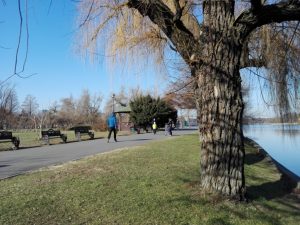
The Kiseleff Road / Şoseaua Kiseleff, one of the six radii starting from the Arch of Triumph, connects with Victoria Square, and, grace to its width and rich vegetation and to the parks setup along the route, it directly related to the Champs-Elysée Boulevard, with its spectacular palaces and magnificent gardens.
Almost two centuries ago, the Kiseleff Road was the favourite promenade place of the Bucharest elite. The trips to the Kiseleff Road were made according to clear rules. Not everyone could afford to make their presence felt there, as a certain social status was needed.
The Road / Şoseaua, as this avenue was called immediately after its inauguration, attracted a lot of investors who opened many elegant places along it, where the gentlemen and the ladies of those times spent their time.

Its name was chosen in remembrance of Count Pavel Kiseleff who, between 1829 and 1834, led the Russian military administration in Wallachia. In fact, it was Count Pavel Kiseleff who took the initiative of creating the Road.
A walk “along the Road / la Şosea” nowadays offers us the opportunity to go past a long line of houses, palaces and extraordinary monuments. In this area we have the opportunity to visit some of the important museums of Bucharest, namely the “Grigore Antipa” National Museum of Natural History, the National Museum of Geology or the National Museum of the Romanian Peasant.
Other important sights for the tourists to see are the Mavrogheni “Healing Spring / Izvorul Tămăduirii” Church, the Buffet on the Road or the Kiseleff Park.
From the Road tourists can easily reach the “Dimitrie Gusti” National Village Museum, as well as the Elisabeta Palace, the Caşin Monastery or the King Mihai I Park.
And these are just some of the attractions that can be reached by the tourists arriving at the Kiseleff Road.
Toward the „heart” of the city

From the Roman Square, the city centre opens with two essential “arteries”: the General Gheorghe Magheru Boulevard and the Dacia Boulevard.
Each of these two wide avenues has its own specific charm and reaches totally different areas of interest.
The General Gheorghe Magheru Boulevard offers the modern traveller access to shopping centres with exclusive brands, hotels and restaurants belonging to famous chains.
Also, the art-loving tourists see opening in front of them a wide range of opportunities. From this boulevard, they can visit the galleries housed in the nearby buildings or the museums along the Victoria Drive.

On both sides of this avenue neighbourhoods open where tourists can strongly feel the flavour of past eras. An example is the Armenian Neighbourhood / Cartierul Armenesc where the air still bears the scents of the goods sold by the Armenian merchants.
Furthermore, following the line described by this boulevard, it is very easy to reach the Old Centre / Centrul Vechi, a place where history blends perfectly with modern life, creating an atmosphere that magnetizes the tourists who come to Bucharest.
Past the University Square / Piaţa Universităţii, this street changes its name to remind of the politician I.C. Bratianu.
And if tourists go along the line of I.C. Bratianu street they arrive at another legendary neighbourhood: the Jewish Neighbourhood / Cartierul Evreiesc, where they can discover a number of synagogues and many a building reminding of the architecture of past eras. And if they choose to go down this route, they can go as far as the banks of the Dâmbovița River, the best depository of Bucharest city’s history.
The boulevards which take the tourists to legendary times
The eclectic Dacia Boulevard, with its historic villas, connects the Roman Square to the Moşilor Drive / Calea Moșilor – another artery destined for trade since the Middle Ages.
And the area between these huge boulevards hides chic parks: the Ioanid Park or the Grădina Icoanei Park, and buildings full of personality, erected according to the plans of the architects who have left their mark upon the city along time: Ion D. Berindey, Ion Mincu, Grigore Cerchez, Albert Galleron etc.
We can also find surprising sights there, such as the Anglican Church of Bucharest, situated at the intersection of Dionisie Lupu Street with Pictor Arthur Verona Street. This building is reminiscent of the British community that could be encountered in Bucharest more than a century ago. The building was erected in 1914, and the architect Victor Ștephănescu was the one who drew up its blueprints.
Another important sight is the Icon Church / Biserica Icoanei, which gave its name to the whole area. This place of worship shelters an icon that miraculously escaped a devastating fire. The church attracts not only the believers who come here to pray, but also the tourists who try to understand the history of these places “told” by the places of worship.
In fact, each of the buildings we discover in the Bucharest of legendary neighbourhoods hides within its walls stories that are always ready to be discovered.
The streets in this part of the city form a kind of spider’s web, and they all “flow” into the wide Gheorghe Magheru Boulevard. Although the travellers seem to wander aimlessly, whenever they all of a sudden arrive at this boulevard they are brought back to the middle of the Bucharest tumult.
From the Unirii Square / Piaţa Unirii, just after crossing the Dâmbovița River, the I.C Brătianu Boulevard changes its name once again to become the Dimitrie Cantemir Boulevard. And this avenue is equally wide and generous.
Hidden by blocks of flats, following the boulevard side along the Dâmbovița River tourists arrive at the Radu Vodă Monastery, sheltering the Theological Orthodox Secondary School. Symmetrically, on the other side of the avenue, tourists can see the Faculty of Orthodox Theology within the University of Bucharest, hidden in a maze of alleys with buildings erected in the early twentieth century or even older.
The end of this artery leaves the traveller in the Youth Park / Parcul Tineretului, an area comprising 200 hectares of green space, which, on the south side, borders the Children’s Town / Orăşelul Copiilor, and on the west side the Carol I Park.

The Bucharest of legendary neighbourhoods can lead the tourists to other equally spectacular areas. There they have the opportunity to see other outstanding buildings that have vanquished time, and also blocks of flat reminiscent of the communist period.
The mixture of styles, cultures and communities that dominate Bucharest render the capital city of Romanian a unique city, satisfying the tastes of any sorts of tourists. Bucharest is open for the travellers eager to breathe history, for the ones in search of fun, as well as for the tourists who seek the peace of a metropolis that has not been completely touched by globalism. All that because Bucharest is a city for everyone!