
 From an architectural point of view, Bucharest is a mixture of styles, and this mixture gave birth to a lively, diverse city, a city where everyone can find oneself. Foreign influences are obvious in today’s Bucharest, where many heritage buildings have been preserved, reminiscent of past times.
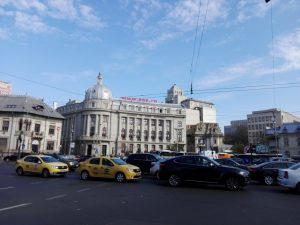
One of the imprints we find on Bucharest comes from way back, from the period of the Phanariote rulers, when the architecture of the place was strongly influenced by the Eastern style.
Nowadays as well, fragments of those houses with specific elements of the Eastern-Balkan architecture have been preserved in some neighbourhoods escaped from the communist bulldozers. We can list here the glass partitions or stucco ornaments, representing flowers birds or fantastic animals.
And yet the most obvious influence of those times can be seen in the structure of the inns that are still standing today. When we set out to retrace the footsteps of the Ottomans, we presented you Manuc’s Inn and Lime Tree Inn.
We are entering the era of classical style
The times passed, however, and Europe was taken away by the frenzy of the classical style. Obviously, Bucharest could not escape this influence.
Thus, starting with the 19th century, more and more buildings were erected in the classic style in Bucharest.
All these constructions are the result of the work of some “import” experts, who came to the Romanian Principalities to demonstrate their skills. It was the period when French, German or Austrian architects, trained in different schools, influenced the new image of the city.
It is the time when downtown Bucharest acquired a new image, and the city became more and more admired by the foreign travellers who were visiting it.
The best example we can give to highlight that era is the Cișmigiu Gardens, a place created by the endeavour of the famous landscape designer Wilhelm Mayer, the former director of the Imperial Gardens of Vienna. He managed to transform an area full of mud and ponds into the most beautiful park Romania’s capital city has today.
Also, during the classic style, they opened the Kiseleff Road, one of the most spectacular traffic routes in Bucharest.
However, we cannot talk about the classic style without mentioning the building of the National Theatre “Ion Luca Caragiale”. It is true that the first building in which the actors of this institution performed was bombed by the Germans during the Second World War, but the theatre was restored in accordance with its initial structure and it illustrates again the classicism of the 19th century Europe.
Three great architects from France, Germany and Austria were involved in this project, each of them being given the mission to put on paper an architectural plan for the theatre building. None of the projects was accepted. Commission after commission met, and a project started in 1836 was completed only on December 31st, 1852, when the theatre was inaugurated. Built according to the models of the Italian theatres, it is said that the National Theatre in Bucharest was the most beautiful in Europe.
What is interesting it that in the period dominated by the classic style, the presence and the Romanian architects trained abroad began to be remarked. This is the case of Alexandru Orăscu, the architect who was “responsible” for the University Palace aspect, the place where several faculties of the University of Bucharest function today. He was the parent of this construction, his plans being at the basis of the works begun in 1857.
The Romantic era
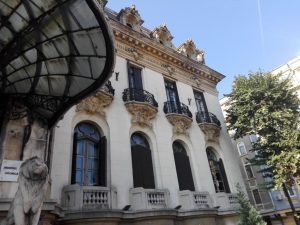
The hardness of the classic style is gradually replaced throughout Europe by a new, romantic style.
An interesting combination of elements, the romantic style stands out, in particular, by acquiring characteristics of feudal architecture, especially of the Gothic aspects. It was the moment when the architecture of Bucharest began to exhibit the vaults on arches, the battlements, the turrets. The most beautiful example of this style is represented by the building of the National History Museum of Romania.
Things kept evolving, and under the influence of French architects, the eclectic style was imposed in our city as well. It is that era that really laid the foundation for the modernization of the city grace to some symbolic buildings such as the Romanian Athenaeum, the National Bank Palace, the CEC Palace, the palace that houses the “George Enescu” Museum, the building of the House of Scientists.
But the time had come for the place of foreign architects to be taken by Romanian ones, who had already started to become famous and impose themselves through monumental works.