
 The people with high financial potential showed their power through the constructions they ordered. Many of these buildings have the signature of important architects from our country or abroad. Bucharest is full of such buildings that the tourist can admire and can enjoy.
Today we will stop at some of the palaces that highlight the city, giving it that air of mystery, of story.
“Biron Palace” in Little Paris
Somewhere on Aviatorilor Boulevard, Alexandru Alley is the Manu-Auschnitt House. The building is owned today by a powerful businessman from our country, but one of the most famous lawyers, Ioan Manu, the son of General Gheorghe Manu, lived here.
The house on Alexandru Alley is one of the most spectacular buildings in the Louis XIV style in Bucharest. The building bears the signature of the architect Grigore Cerchez and is a faithful copy of the Biron Palace in Paris.
Ioan Manu built this magnificent palace to live here with his wife Elisabeta (Zetta) Cantacuzino. Unfortunately, the Manu family was able to enjoy this house, completed in 1915, only until 1932, when Ioan Manu went bankrupt and was forced to sell the palace to the industrialist Max Auschnitt.
Crețulescu Palace and Cișmigiu Park
Very close to Cișmigiu Park, on Știrbei Voda Street, is Crețulescu Palace. The building, which belongs today to the Ministry of Education and Research, was erected at the orders of Elena Kretzulescu, descendant of large families of boyars.
In 1902, Elena Kretzulescu hired the architect Petre Antonescu to design a building in the style of the French Renaissance with baroque influences. Around the impressive building, its owner has set up a magnificent park, which will later become Cișmigiu Park.
Fairytale palaces
Another impressed palace of Bucharest is the one built by the ruler Grigore Dimitrie Ghica, in 1822.
The Ghica Tei Palace was built according to the plans of the architect Xavier Villacrosse and is a construction made in the neoclassical style, with strong Italian influences.
Emblematic for the inter-war Bucharest, the H. Spayer Palace on Batiștei Street, number 24 A, is also known as the Marmorosch Blank House.
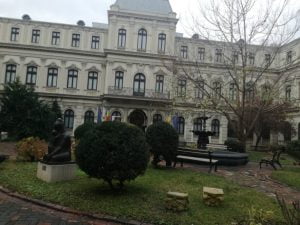
The building dates from 1900 and was designed by the architect Louis Blanc. Herman Spayer ordered him to erect this building in order to highlight its financial strength.
The Romanit Palace, a building that today houses the Museum of Art Collections, cannot be missing from such a presentation.
The building located on Calea Victoriei, at number 111 was built at the orders of the boyar C. Faca. He died before his project was completed, and the heirs decided to sell the palace to the Greek Chief Treasurer Romanit, who, moreover, will complete the building.
In its turn, the Șuțu Palace houses the Bucharest Municipal Museum. The building on Ion C. Brătianu Boulevard, number 2, is one of the most spectacular aristocratic residences in Bucharest. The one who ordered this construction was the seneschal Costache Șuțu. The works were carried out between 1833 and 1835 and complied with the plans drawn up by the architects Conrad Schwink and Johann Veit. Also, the interior of this impressive building was designed by the well-known artist Karl Storck.
We will end this tour with the Suter Palace, located near the Carol I Park. In this building with an impressive story, a famous hotel in Bucharest is operating today.
The Swiss architect Gustav Adolf Suter, a very good friend of King Carol I of Romania, wanted to have a residence in Bucharest according to his reputation. Thus was born the project that was the basis of the construction of one of the most beautiful buildings that we can admire today in the capital of Romania.
Moreover, the famous architect has made a strong impression on the image of Bucharest, when King Carol I called his friend for help and entrusted his first studies on the vanishing wetlands in Filaret and the transformation of the place into a beautiful park.
Returning to the Suter Palace, it was built between 1902 – 1906 and respects the neoclassical style, having strong Brâncovenești influences. After the death of architect Gustav Adolf Suter, the building passed to several owners. One of them, a Greek banker, bought it in 1940 and gave it to his mistress.
The many palaces we can admire all over Bucharest hide the interesting stories that reveal the influences of large families in the development of this city.